



Water Balance Discrepancies in Distribution Networks: Where Electromagnetic Flow Measurement Helps
A water distribution network may deliver a steady supply to consumers while reporting a difference between the volume entering the network and the volume recorded at its delivery points. For utility operators, this discrepancy raises an important concern: where is the water going, and how accurately is it being measured?
Not every difference indicates a pipeline leak. Water balance discrepancies can result from physical losses, unrecorded consumption, inaccurate meters, operational activities, or inconsistent measurement periods. Without dependable flow data, identifying the actual cause becomes difficult.
A magnetic flow meter helps utilities measure the volume of water passing through pipelines, providing information that can be compared across supply points and distribution zones. With accurate measurements at selected locations, we can support better visibility into network performance and help operators investigate discrepancies before they develop into larger operational concerns.
When Water Entering the Network Does Not Match Recorded Consumption
Consider a distribution zone receiving 10,000 cubic metres of water over a defined monitoring period. During the same period, the total recorded consumption and authorised operational use account for only 9,200 cubic metres.
The remaining 800 cubic metres represent a water balance discrepancy that requires investigation.
This difference could arise from several sources:
- Undetected pipeline leakage: Water escapes through damaged pipes, joints, or underground connections.
- Metering inaccuracies: Existing meters may under-register or over-register flow.
- Unrecorded authorised consumption: Water used for flushing, firefighting, or other approved activities may not be fully documented.
- Unauthorised consumption: Water may be withdrawn without corresponding consumption records.
- Data collection differences: Readings taken at different times can create misleading comparisons.
- Changes in network storage: Filling or emptying reservoirs and storage tanks can affect the balance during the measurement period.
The first step towards understanding these differences is establishing reliable measurement at the network's main supply and distribution points.
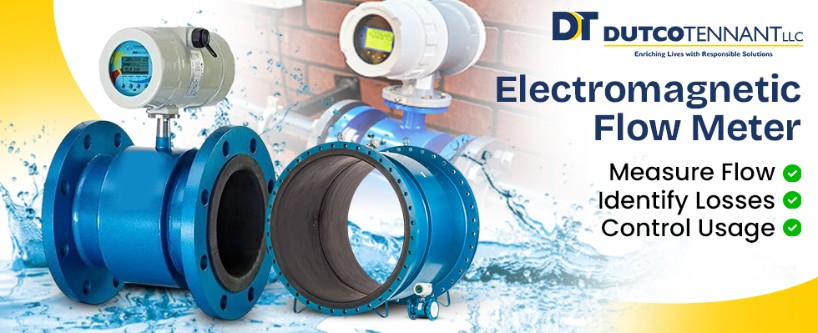
This is where an electromagnetic flow meter becomes valuable. It measures flow directly within a conductive liquid pipeline, helping operators establish consistent data for water balance calculations.
How Electromagnetic Flow Measurement Makes Network Losses Easier to Investigate
Electromagnetic flow measurement works according to Faraday's law of electromagnetic induction. As conductive water passes through a magnetic field generated by the sensor, a voltage is induced between the measuring electrodes. The instrument uses this signal to determine flow velocity and calculate volumetric flow.
Unlike mechanical flow measurement technologies, electromagnetic meters do not require moving measuring components inside the flow path.
For water distribution applications, this provides several practical advantages.
Measuring Flow Without Internal Moving Parts
Mechanical measuring components can experience wear over time, particularly in systems operating continuously.
Electromagnetic measurement avoids internal rotating mechanisms, reducing mechanical wear associated with the measuring principle.
With no moving measuring parts obstructing the flow path, the meter also introduces minimal additional pressure loss when correctly sized and installed.
Recording Flow in Both Directions
Water movement within a distribution network is not always constant in one direction. Changes in valve positions, pumping arrangements, or network operating conditions may cause temporary flow reversal.
A meter capable of bidirectional measurement helps identify these conditions and provides a clearer understanding of water movement.
This is especially useful when evaluating interconnected distribution zones.
Monitoring Changes in Flow Patterns
A sudden increase in flow during periods of normally low demand may indicate an operational change or a possible leakage event.
By collecting flow readings over time, operators can compare current conditions with historical patterns and investigate unusual variations.
Effective water distribution flow monitoring therefore depends on both reliable instruments and appropriate interpretation of the recorded data.
Where Flow Meters Should Be Installed to Improve Water Balance Visibility?
The location of a flow meter determines how useful its readings will be for network analysis.
A single measurement at the main supply point provides information about total inflow, but it cannot identify where a discrepancy occurs across an extensive distribution system.
Placing meters at selected network boundaries allows operators to divide the system into smaller monitoring areas and compare the water entering and leaving each section.
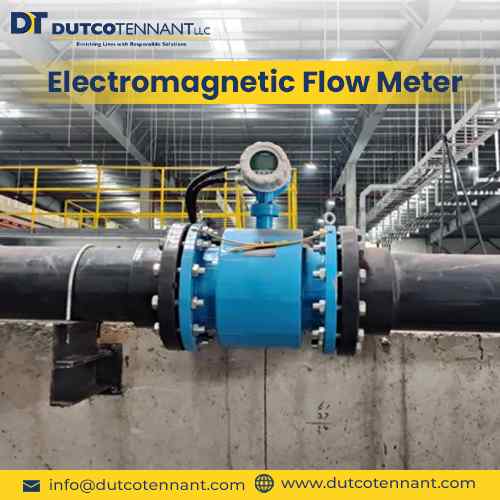
For example, a bulk water flow meter installed at the entrance to a distribution zone establishes its incoming volume. Additional meters at interconnections or outgoing pipelines can help account for water transferred elsewhere.
These measurements become more useful when combined with customer consumption records, operational data, and consistent monitoring periods.
Understanding the Role of District Metered Areas
District Metered Areas (DMAs) are defined sections of a water distribution network where flows across the boundaries are measured or controlled.
By monitoring water entering and leaving a DMA, operators can calculate its water balance and assess unusual consumption patterns.
Electromagnetic meters are particularly relevant at these locations because they support continuous measurement of conductive water without internal moving measuring components.
However, a meter does not independently locate underground leakage. It provides flow information that can guide further investigation using pressure monitoring, acoustic detection, network analysis, or field inspections.
Flow Measurement with the MUT2200EL Electromagnetic Sensor
Reliable network monitoring requires measurement equipment that can operate under varying flow conditions while maintaining dependable performance.
Our electromagnetic flow meter solutions include MUT2200EL, a flanged electromagnetic sensor developed for water cycle and industrial process applications.
The sensor combines a robust construction with measurement features relevant to municipal water distribution and utility infrastructure.
Its key characteristics include:
- High measurement accuracy: Supports reliable flow measurement across a wide operating range.
- Bidirectional measurement: Measures water movement in either direction.
- Empty-pipe detection: An empty-pipe electrode is supplied as standard for sizes DN50 and above.
- Converter compatibility: Can be paired with Euromag converters for flow measurement and signal processing.
- Robust construction: Features fully welded and potted construction.
- Wet calibration: In-house wet calibration is available across the manufacturer's diameter range up to DN2000.
- Installation options: Available with different housing and flange materials, including stainless steel options.
- Environmental protection: IP68 protection is specified for permanent immersion in water up to 1.5 metres under the manufacturer's stated conditions.
The MUT2200EL is applicable to water distribution, water treatment, irrigation, pumping stations, and other conductive liquid measurement requirements.
For potable water projects, relevant drinking water approvals and the exact instrument configuration should be reviewed against the applicable project specifications.
Matching Meter Selection to Network Conditions
Measurement accuracy depends not only on the instrument but also on how it is selected and installed.
For a distribution pipeline, the meter diameter and expected flow velocity must be considered together. An oversized instrument may operate at very low velocities during off-peak periods, while an undersized meter may create unsuitable operating conditions.
Installation also requires attention to:
- Pipe-full conditions at the measuring location
- Appropriate upstream and downstream piping arrangements
- Electrical grounding and bonding requirements
- Suitable liner and electrode materials
- Expected operating pressure and water conductivity
- Converter configuration and communication requirements
These factors influence measurement quality and should be reviewed during system design and commissioning.
Turning Flow Readings into Useful Water Balance Information
Collecting flow data is only the beginning. The operational value comes from comparing measurements and understanding what the differences indicate.
For example, when a utility records higher-than-expected night-time flow, the information may justify further investigation. However, the increase could also result from legitimate night-time consumption, reservoir filling, or changes in network operation.
A meaningful assessment requires flow readings to be considered alongside pressure conditions, customer demand, valve operations, and other network activities.
Our measurement solutions can contribute to this process by providing dependable flow information at key locations.
For projects requiring an electromagnetic flowmeter UAE utilities can consider, the MUT2200EL provides features relevant to distribution monitoring, including bidirectional measurement and compatibility with different converter arrangements.
Where the selected converter and monitoring infrastructure support the required functions, flow data can also be incorporated into supervisory and automation systems for ongoing network assessment.
Better Water Balance Decisions Begin with Dependable Measurement
Water balance discrepancies cannot be resolved through measurement alone, but reliable flow data makes it easier to determine where further investigation is needed.
By establishing accurate readings at supply points, distribution boundaries, and selected network connections, utilities gain a stronger basis for comparing delivered volumes with recorded consumption.
At Dutco Tennant LLC, we bring electromagnetic flow measurement solutions to water and utility infrastructure applications across the UAE. The MUT2200EL sensor provides a practical option for projects requiring continuous flow measurement, bidirectional monitoring, and robust instrument construction.
A correctly selected and installed magnetic flow meter helps transform unexplained water balance differences into measurable information, supporting informed network management, targeted leakage investigations, and more effective use of available water resources.