
Smart Metering Rollouts in the GCC: Single-Phase vs. Multirange Meters Explained
Smart metering programmes across the GCC can cover a wide range of consumers, from individual residential connections to commercial and larger three-phase installations. These connections do not necessarily require the same meter configuration.
A single-phase household connection may be suitable for direct-connected metering, while larger three-phase consumers can require measurement through current transformers or current and voltage transformers. Understanding this difference is an important starting point when utilities plan meter standardisation, communications infrastructure and future network expansion.
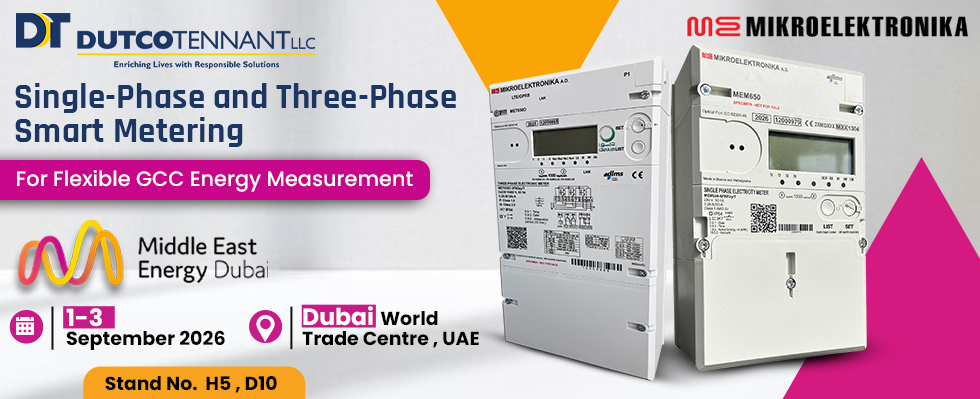
We support different metering requirements through solutions including the single-phase MEM650 and three-phase MET650 multirange meter. At Middle East Energy Exhibition 2026, we will showcase smart metering technologies as part of our electrical solutions portfolio.
Visitors can meet us from 1–3 September 2026 at Dubai World Trade Centre, UAE, Hall H5, Stand D10 to discuss utility and project-specific metering requirements.
Why One Meter Configuration Does Not Suit Every Connection
Large smart metering rollouts usually contain several customer categories.
Residential properties and other lower-capacity connections may use single-phase direct-connected meters. Commercial, infrastructure and larger electrical installations can involve three-phase networks and instrument-transformer-based measurement.
This means meter selection should begin with the electrical connection rather than the communication technology alone.
When we review a smart metering rollout in the Middle East Energy, we consider questions such as:
- Is the connection single-phase or three-phase?
- Is direct or transformer-operated measurement required?
- What current and voltage conditions apply?
- Which tariff structure needs to be supported?
- Is bidirectional energy measurement required?
- How will meter data be communicated?
- What environmental conditions will the meter experience?
Answering these questions helps divide a large rollout into logical meter categories.
MEM650: Where Single-Phase Direct Metering Fits
The MEM650 is a single-phase, two-wire electronic electricity meter designed for direct connection to a 230V network.
Its primary application includes household electricity smart metering, making it relevant for large populations of residential and similar single-phase consumers.
For projects evaluating a single phase smart meter supplier in the UAE, the direct-connected architecture is an important distinction.
Current passes through the meter rather than being measured through an external current-transformer arrangement. The meter is available with nominal current options of 5A and 10A, with maximum-current configurations ranging from 40A to 120A depending on the selected version.
This allows the specific meter configuration to be matched to the applicable service connection rather than applying one current rating across an entire rollout.
Smart Metering Requires More Than Recording kWh
Modern electricity metering can involve considerably more information than a cumulative energy reading.
The MEM650 calculates active and reactive energy and power. It supports one-direction measurement, measurement in both directions, absolute energy measurement and four-quadrant measurement.
This capability becomes useful as electrical networks evolve.
Some connections may operate purely as consumption points, while others may need to account for electricity flowing in more than one direction. Where distributed generation or another applicable arrangement changes the direction of energy flow, the metering system needs to record that behaviour correctly.
When we assess meter requirements, we therefore recommend considering how the connection could operate over the expected service life of the equipment rather than looking only at its present configuration.
Why Multi-Tariff Capability Matters to Utilities
Tariff structures can also become more sophisticated over the lifetime of a smart metering programme.
The MEM650 supports up to eight tariffs, with tariff switching controlled through its internal real-time calendar or an external control arrangement.
Tariff scheduling can account for seasons and special days as part of the programmed configuration.
For utilities, this creates flexibility to support different billing periods without requiring a completely different basic metering platform for each tariff arrangement.
We recommend defining expected tariff requirements during the specification stage. This helps ensure the selected meter provides suitable functionality for both current billing arrangements and reasonably anticipated programme development.
When Should We Move From Single-Phase to Three-Phase Metering?
The change is determined by the electrical connection.
For larger three-phase consumers, direct-connected single-phase metering is no longer the appropriate architecture. Measurement may need to take place through instrument transformers depending on the installation.
This is where the MET650 multirange meterprovides a different approach.
The MET650 multirange configuration supports three-phase measurement across an extended voltage range from 3 x 57.7/100V to 3 x 230/400V.
It can operate with CT and CT/VT measurement arrangements and determines the applicable connection according to the voltage conditions.
For a multirange electricity meter in GCC projects, this flexibility can be useful where utilities or infrastructure programmes contain different three-phase measurement configurations.
Why Multirange Capability Can Simplify a Metering Programme
Meter standardisation can become challenging when a network contains several connection arrangements.
Every additional meter type can introduce another item to procure, configure, stock, document and support.
A multirange meter can help address this issue where its supported electrical configurations correspond with the installations included in the programme.
The MET650 provides measurement of active and reactive energy and supports multiple measurement modes together with multi-tariff functionality.
This does not mean one meter should automatically be selected for every three-phase connection. The actual CT or CT/VT arrangement, voltage, current, accuracy and utility requirements still need to be checked.
For us, the advantage is the opportunity to evaluate a broader set of three-phase applications within a common meter platform.
MEM650 or MET650: A Practical Selection View
The choice becomes clearer when we begin with the connection architecture.
| Selection Factor | MEM650 | MET650 Multirange |
|---|---|---|
| Electrical system | Single-phase, two-wire | Three-phase |
| Connection approach | Direct connected | CT or CT/VT |
| Typical selection context | Residential and similar single-phase connections | Larger three-phase measurement points |
| Tariff capability | Up to 8 tariffs | Up to 8 tariffs |
| Energy measurement | Active and reactive | Active and reactive |
| Bidirectional measurement | Supported | Supported |
| Enclosure protection | IP54 | IP54 |
We use these distinctions as an initial selection framework. The final meter specification still needs to reflect the utility's electrical, accuracy, communication and integration requirements.
Communications Need to Be Planned With the Meter Rollout
A meter becomes part of a smart metering system when its data can be collected and used effectively.
Both meter families provide communication possibilities that include an optical interface as well as options such as RS485, M-Bus and HAN. Configurable main communication technologies can include GSM/GPRS, LTE/LTE-M, NB-IoT, PLC and Ethernet depending on the selected meter configuration.
This flexibility is useful because communications conditions can vary considerably across a network.
A dense urban development may have different connectivity requirements from a remote infrastructure location. Building characteristics, network coverage, available communications infrastructure and data-management architecture can all influence the appropriate choice.
When we work with a utility or project team, we recommend evaluating meter hardware and communication architecture together rather than treating connectivity as a later addition.
Environmental Conditions Should Be Part of the Specification
Meters installed across GCC networks may experience demanding ambient conditions.
The MEM650 and MET650 documentation specifies an operating temperature range from -40°C to +70°C, together with IP54 enclosure protection.
These specifications provide useful parameters for technical evaluation, but installation conditions still need to be assessed for each project.
Location, enclosure arrangement, exposure, ventilation and applicable utility requirements should all be considered before approving a meter for a particular installation.
This is especially relevant for large deployments because environmental assumptions made during specification can affect thousands of installed devices.
What Should Procurement Teams Define Before Ordering?
A request for a direct connect energy meter supplier or three-phase smart metering solution should include enough technical information for the meter to be evaluated correctly.
We recommend separating the requirement into three groups.
Electrical requirements should define phase configuration, connection type, voltage, current and required measurement characteristics.
Smart metering requirements should cover tariffs, bidirectional measurement where applicable, communications interfaces and integration expectations.
Installation requirements should address environmental conditions, enclosure requirements and the physical configuration of the metering point.
This creates a clearer technical specification and reduces the likelihood of selecting a meter primarily because it carries the broad label of "smart meter".
Plan the Meter Population Before Planning the Quantity
For a large rollout, we recommend segmenting the planned meter population before final quantities are established.
Residential direct-connected customers can form one group. Three-phase transformer-operated connections can form another. Additional segmentation can then be applied where communication technologies or other project requirements differ.
This approach can improve procurement planning, inventory control and field deployment.
Installation teams can also receive clearer instructions when meter categories correspond with defined connection types.
For utilities planning thousands of metering points, this classification can be more valuable than attempting to maximise standardisation at the expense of correct electrical application.
Discuss Smart Metering With Us at Middle East Energy 2026
At Middle East Energy 2026, we will showcase smart metering technologies alongside our wider electrical, transmission and distribution solutions.
Utilities, consultants, EPC contractors, developers and infrastructure teams can meet us at Hall H5, Stand D10, Dubai World Trade Centre, from 1–3 September 2026.
Our team will be available to discuss single-phase direct-connected metering, three-phase multirange measurement, communication options and the requirements of upcoming GCC smart metering programmes.
A successful rollout begins by recognising that the meter population is rarely uniform. By separating single-phase direct-connected consumers from more complex three-phase measurement points and then considering communications, tariffs and future requirements, we can help project teams build a clearer foundation for scalable smart metering.