
Understanding Pressure Reducing Valve Operation in Modern Water Distribution Systems
A water distribution network must manage two different conditions: the pressure at which water enters the system and the quantity of water available in storage. Both can change throughout the day, particularly in large buildings, commercial developments, and industrial facilities.
High inlet pressure can place unnecessary stress on plumbing fixtures, valves, and connected equipment. Meanwhile, uncontrolled tank filling can lead to inconsistent water levels and inefficient operation. These challenges require different forms of regulation, but both influence the reliability of the overall water supply.
Pressure reducing valves help maintain suitable downstream pressure, while float valves regulate water entering storage tanks according to the water level.
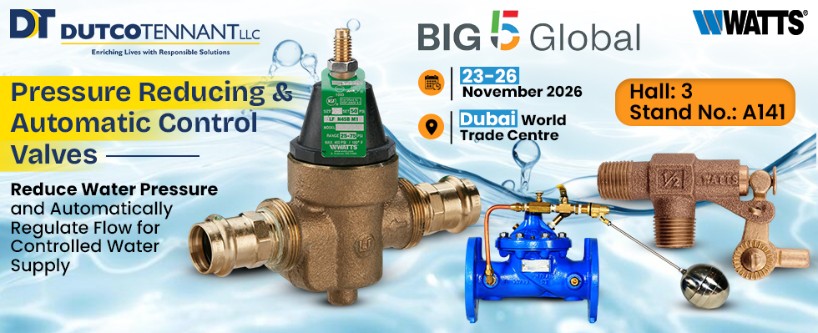
At Big 5 Global 2026, Dutco Tennant LLC will feature pressure management and tank-level control technologies from Watts, including the LFN45B Pressure Reducing Valve, W-M115-74 Pressure Reducing Control Valve, ST500 Mechanical Float Valve, and W-M110-10 Modulating Float Control Valve.
These products illustrate how water distribution systems can be managed through a combination of direct-acting pressure regulation, automatic hydraulic control, and mechanical or pilot-operated tank filling.
What Happens Inside a Pressure Reducing Valve?
A Pressure Reducing Valve (PRV) is installed to reduce a higher upstream water pressure to a controlled lower pressure downstream.
In a typical direct-acting PRV, a spring and diaphragm mechanism responds to downstream pressure. When water demand increases and downstream pressure falls, the regulating mechanism opens further to permit additional flow. As demand decreases and downstream pressure rises, the valve moves towards a more restricted position.
This automatic response helps maintain pressure near the selected setting within the valve's operating range.
The function becomes particularly important in high-rise developments, commercial plumbing networks, and installations where incoming water pressure exceeds the requirements of downstream equipment.
A correctly selected Water Pressure Regulator can help:
- Reduce excessive pressure at plumbing fixtures.
- Limit unnecessary stress on connected components.
- Support more consistent water delivery.
- Reduce water consumption associated with excessive outlet pressure.
- Improve the operating conditions of downstream plumbing equipment.
The effectiveness of a Plumbing Pressure Reducing Valve depends on its sizing, inlet pressure, required outlet pressure, flow range, and installation conditions.
Watts LFN45B – Direct-Acting Pressure Regulation for Building Plumbing
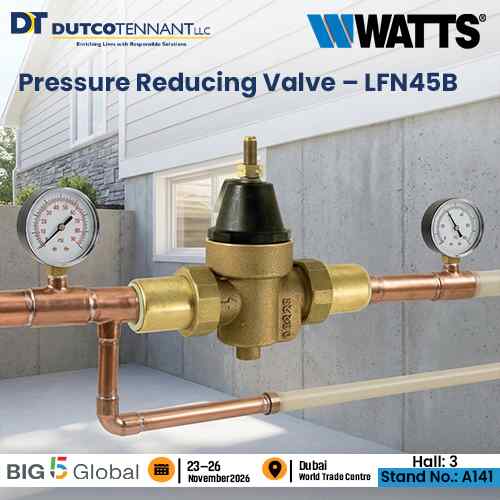
The Watts LFN45B Pressure Reducing Valve is intended for residential and commercial water supply applications where incoming pressure must be reduced to a predetermined level.
Available in sizes from ½ inch to 1 inch (15–25 mm), the LFN45B is a lead-free water pressure reducing valve designed for serviceability and installation flexibility.
The valve accommodates water supply pressures up to 400 psi. Its standard outlet pressure setting is 50 psi, with an adjustable range of 25–75 psi (172–517 kPa).
These characteristics make the LFN45B suitable for appropriately sized plumbing installations where consistent downstream pressure is required.
Product Details That Matter During Installation
Integrated Stainless Steel Strainer
The valve incorporates a stainless steel strainer that helps prevent debris from interfering with the regulating mechanism.
Thermal Expansion Bypass
An integrated bypass feature helps control pressure associated with thermal expansion under suitable system conditions. Its function must be considered alongside any required dedicated thermal expansion protection.
Accessible Maintenance
The LFN45B is designed for servicing without removing the valve from the pipeline, which can simplify maintenance activities.
Sealed Spring Cage
Its sealed spring cage supports installation in accessible outdoor locations or pits, subject to the manufacturer's requirements.
Multiple Connection Arrangements
Watts offers threaded, solder, PEX, quick-connect, CPVC, press, and cold-expansion PEX connection options across the range.
For contractors specifying a Commercial Plumbing PRV, these features provide flexibility when integrating pressure regulation into different pipework arrangements.
The LFN45B can also be evaluated as a Water Supply PRV for suitable building service applications where excessive inlet pressure must be reduced before reaching downstream fixtures.
In projects requiring a Pressure Reducing Valve Dubai solution, the product's pressure setting, connection configuration, and serviceability are important selection considerations.
When Water Demand Changes: The Watts W-M115-74 Low-Flow Bypass PRV
Not all water distribution systems operate at a consistent flow rate.
A commercial building may experience high water demand during busy operating periods, followed by substantially lower demand overnight. The same network must maintain acceptable downstream pressure under both conditions.
This presents a challenge for larger pressure reducing control valves, particularly when actual flow falls below the range in which the main valve regulates effectively.
The Watts W-M115-74 addresses this condition through a dedicated low-flow bypass arrangement.
How the Low-Flow Bypass Works
The W-M115-74 is a pressure reducing control valve intended to automatically reduce fluctuating higher upstream pressure to a lower downstream pressure despite variations in flow demand.
Its arrangement incorporates a separate, valve-mounted, direct-acting pressure reducing valve that handles flow requirements below the normal operating range of the main pressure reducing control valve.
When demand is within the main valve's operating range, the main control valve regulates downstream pressure. During very low demand, the bypass valve provides a dedicated regulation path.
This arrangement extends the system's ability to manage pressure across a wider range of operating conditions.
Why Low-Flow Regulation Is Important
In large water supply networks, a pressure reducing valve may be sized for substantial peak demand. However, low-demand conditions can be equally important to overall system stability.
The Low Flow Bypass Pressure Reducing Valve arrangement helps address this mismatch between peak and minimum demand.
Its operating principle is relevant to:
- Commercial buildings with variable occupancy.
- Water distribution networks experiencing significant daily demand changes.
- Industrial facilities with intermittent water consumption.
- Large plumbing installations requiring pressure regulation across different flow conditions.
For consultants evaluating a Pilot Operated Pressure Reducing Valve, the W-M115-74 provides a control arrangement intended for applications where the mainline valve and low-flow bypass must work together.
As an Industrial PRV, it can be considered for suitable distribution systems requiring automatic pressure management.
The product is also relevant to Water Pressure Control Valve and Pressure Reducing Control Valve Dubai specifications where stable downstream pressure is required across variable demand conditions.
Unlike a conventional small direct-acting regulator, the W-M115-74 addresses a broader hydraulic control requirement through its main valve and bypass arrangement.
Pressure Control Is Only Half the Water Management Challenge
Even when pipeline pressure is correctly regulated, a building still needs an effective method of maintaining water levels in its storage tanks.
In commercial and industrial facilities, storage tanks help accommodate variations in water consumption and provide water for connected distribution systems.
However, uncontrolled tank filling can create problems. If the inlet remains open after the required water level is reached, overflow may occur. If the inlet closes prematurely or fails to reopen, the available stored water may fall below the intended operating level.
Float valves address this requirement by responding to the water level rather than the pressure in the downstream distribution network.
Watts offers both mechanical float valves and hydraulically operated float control arrangements for different tank-filling requirements.
Watts ST500 – Mechanical Float Valve for Automatic Tank Filling
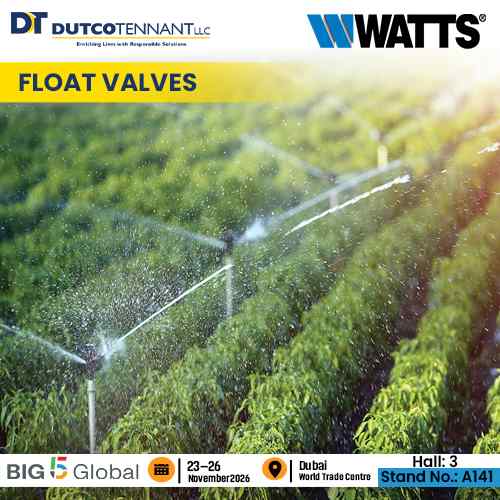
The Watts ST500 is a standard-duty mechanical float valve used to control water flow in commercial, industrial, and agricultural applications.
It operates through a mechanical float arrangement. As the water level changes, movement of the float operates the valve mechanism to regulate the incoming supply.
This provides an automatic method of maintaining water levels without requiring an electronic controller.
The ST500 features a bronze body with a ½-inch male NPT threaded connection, cotter-pin pivot arm assembly, replaceable seals, and replaceable plungers.
Watts specifies a maximum operating pressure of 125 psi (8.7 bar) and identifies air conditioning, refrigeration, and irrigation systems among its applications.
Watts
Mechanical Simplicity for Water Level Regulation
The ST500 offers a practical solution where direct mechanical control is appropriate.
Its bronze construction provides a durable valve body for compatible water applications, while the replaceable internal components support maintenance when required.
The mechanical float arrangement also eliminates the need for a separate electrical signal to operate the valve.
For smaller tanks and suitable equipment applications, the Water Tank Float Valve can help maintain the required water level through automatic inlet control.
The ST500 is relevant to several operating environments:
- Air Conditioning and Refrigeration Systems: Suitable applications may require automatic replenishment of water within associated equipment or storage arrangements.
- Irrigation Installations: A Mechanical Float Valve can regulate water entering compatible storage tanks used in agricultural and landscape irrigation systems.
- Commercial Water Storage: The valve can be considered where a compact Automatic Tank Filling Valve is required and its flow capacity meets the installation requirements.
For projects evaluating a Float Valve Dubai solution, the ST500 provides a mechanically operated Water Level Control Valve option that can be selected according to tank configuration, operating pressure, and inlet connection requirements.
Watts W-M110-10 – Hydraulic Float Control for Larger Water Storage Applications
Larger storage tanks may require a different method of controlling incoming water.
In these installations, the main water supply valve may be located away from the tank's water surface, while the control mechanism must still respond to changes in liquid level.
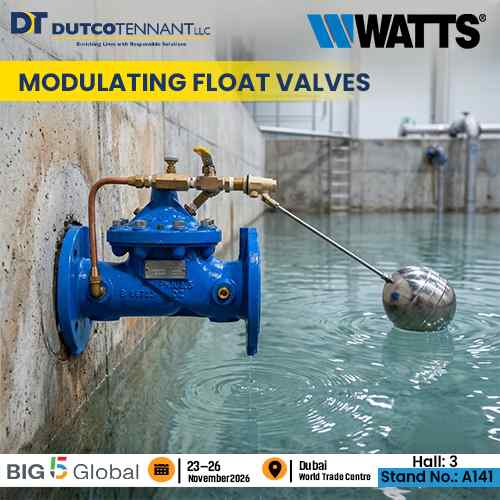
The Watts W-M110-10 Modulating Float Control Valve uses a hydraulic control arrangement consisting of a main valve and an adjustable float valve.
The float mechanism responds to the water level and controls the opening and closing of the main valve.
Once the required level has been adjusted, the system regulates incoming water to maintain the selected level.
Watts identifies water supply tanks, industrial water storage, and residential building tanks among the product's applications.
Watts
A Different Approach to Tank Level Management
The W-M110-10 provides several features relevant to larger water storage installations.
Hydraulically Controlled Main Valve
The float mechanism operates the main valve through a hydraulic control arrangement, allowing the water level to determine inlet operation.
Adjustable Water Level
The required liquid level can be set according to the tank's operating requirements.
Controlled Opening and Closing
A needle valve allows the opening and closing speed of the main valve to be adjusted.
Compact Construction
Watts specifies a compact arrangement with reliable sealing and a structure intended to simplify maintenance.
The ability to adjust valve operating speed is particularly relevant where abrupt changes in inlet flow are undesirable.
As a Hydraulic Float Control Valve, the W-M110-10 offers an alternative to direct mechanical float valves for suitable storage systems.
Its automatic operation makes it relevant to Water Reservoir Float Valve and Automatic Tank Level Control Valve requirements in commercial and industrial water supply installations.
For projects requiring a Pilot Operated Float Valve, the W-M110-10 provides a hydraulically controlled arrangement in which the float mechanism governs main valve operation.
The product can also be evaluated for Modulating Float Valve Dubai applications where tank filling must respond automatically to changes in stored water level.
How Pressure Regulation and Tank Level Control Work Together
Consider a commercial development with a ground-level water storage tank and a pumped distribution network serving several floors.
Water enters the storage tank through an inlet arrangement. A float control valve regulates the incoming supply according to the tank's water level.
From the tank, pumps distribute water through the building.
Depending on the system design, pressure reducing valves may be installed at appropriate locations to maintain suitable pressure for downstream plumbing fixtures and equipment.
The two control functions operate independently but contribute to the same water supply arrangement.
Tank level control determines when water should enter storage.
Pressure regulation determines the pressure at which water should be delivered downstream.
The distinction is important because a pressure reducing valve does not regulate tank filling according to water level, and a float valve does not replace a dedicated pressure reducing valve.
For consultants designing modern water distribution networks, selecting the correct control arrangement helps maintain the intended relationship between storage, pumping, and water delivery.
Choosing the Appropriate Watts Valve for Each Operating Requirement
The featured Watts products address different hydraulic conditions.
| Water system requirement | Watts product | Main operating function |
|---|---|---|
| Reducing incoming pressure in smaller plumbing lines | LFN45B | Direct-acting downstream pressure regulation |
| Maintaining pressure across widely varying demand | W-M115-74 | Pressure reducing control with low-flow bypass |
| Controlling water level through a mechanical float | ST500 | Mechanical inlet flow control |
| Regulating tank filling through a hydraulic main valve | W-M110-10 | Float-controlled hydraulic valve operation |
This selection highlights why valve sizing and operating principles should be evaluated before specifying equipment.
For example, the LFN45B may be suitable for a smaller building water supply connection, while a larger network with substantial flow variation may require the W-M115-74 arrangement.
Similarly, the ST500 can be considered for appropriate standard-duty tank-filling applications, whereas the W-M110-10 addresses requirements involving a hydraulically operated main valve.
The final selection should account for flow capacity, operating pressure, installation orientation, fluid compatibility, maintenance access, and the required control response.
Important Design Considerations for Water Pressure and Tank Control
Pressure Zones in Multi-Storey Buildings
In taller buildings, water pressure can vary considerably between floors because of elevation differences.
A Water Pressure Regulation Valve may be required to maintain suitable pressure within designated distribution zones.
The design must account for static pressure, operating pressure, and the minimum pressure required at the most demanding fixtures.
Changes in Water Consumption
Peak demand and minimum demand can differ significantly in hotels, commercial towers, and mixed-use developments.
Where the flow range is particularly wide, a Low Flow Bypass Pressure Reducing Valve may offer advantages over an arrangement that relies on a single mainline control valve.
Water Storage Capacity
Tank level control should be coordinated with the required storage volume and the building's operating requirements.
The selected Float Valve must provide adequate filling capacity without exceeding the manufacturer's operating limits.
Maintenance and Inspection
Pressure regulators and float valves contain moving components that may require periodic inspection.
Accessible installation locations, suitable isolation arrangements, and maintenance procedures help support dependable operation.
These considerations are particularly relevant for consultants and contractors selecting a Plumbing Pressure Control Valve or automatic tank-filling arrangement for long-term building use.
Watts Pressure Reducing Valves at Big 5 Global 2026
Reliable water distribution depends on controlling both the pressure delivered to users and the quantity of water maintained in storage.
Watts addresses these requirements through different valve operating principles, from the direct-acting LFN45B and low-flow bypass W-M115-74 to the mechanically operated ST500 and hydraulically controlled W-M110-10.
At Dutco Tennant LLC, we will present these technologies as part of our Pressure Reducing Valves at Big 5 Global showcase, focusing on their relevance to commercial plumbing, industrial water supply, and automatic storage tank management.
The featured products offer consultants, MEP contractors, and developers an opportunity to examine different approaches to water pressure and level regulation.
Our team will be available during Big 5 Global Exhibition 2026, from 23–26 November 2026 at Dubai World Trade Centre, Hall 3, Stand 3A141, to discuss suitable Watts valve configurations for upcoming building and infrastructure projects.
By matching valve operation to the actual requirements of the water distribution network, projects can achieve more controlled pressure, dependable tank filling, and better-managed water supply conditions.