



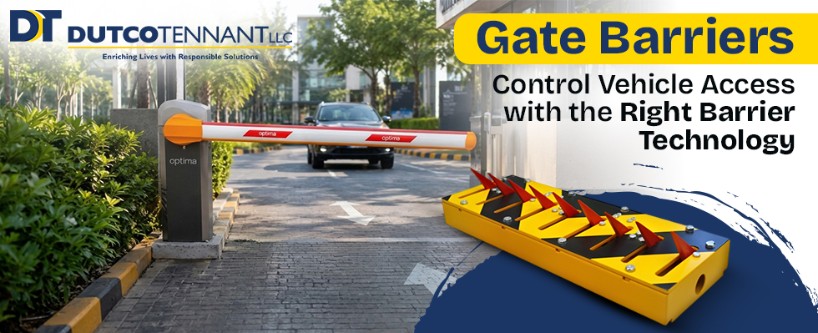
Vehicle Access Control Solutions: Gate Barrier Types, Features and Applications
Effective vehicle access management plays an important role in maintaining security, traffic discipline and operational efficiency across commercial, industrial and institutional facilities. A commercial parking facility requires smooth vehicle movement, an industrial facility needs controlled access for heavy vehicles, while critical infrastructure demands reinforced perimeter protection.
Although these environments share a common requirement for controlled vehicle access, their security and operational requirements differ considerably.
Traffic frequency, lane width, security requirements, operating mechanisms, environmental exposure and compatibility with access control infrastructure all influence the selection of gate barriers.
As a gate barriers supplier in the UAE, Dutco Tennant LLC supplies a comprehensive range of vehicle access control solutions, including hydraulic arm barriers, road blockers and tyre killers, for projects across the UAE and GCC.
This guide explains the features, operating characteristics and applications of these products, highlights their differences and explores how they address different vehicle access management requirements.
Gate Barriers for Controlled Vehicle Entry and Perimeter Security
Vehicle access control involves more than opening and closing an entrance. It requires coordination between physical security equipment, vehicle identification systems and traffic management infrastructure.
A gate barrier regulates vehicle movement at designated entry and exit points. Different barrier technologies address different operational and security requirements.
Arm barriers primarily manage routine vehicle access, road blockers provide physical resistance against vehicle intrusion, and tyre killers serve specialised vehicle restriction requirements.
These technologies can operate independently or as part of an integrated security system, depending on the facility's requirements.
Hydraulic Arm Barriers for High-Frequency Vehicle Access
A Hydraulic Arm Barrier uses a hydraulic drive mechanism to raise and lower a barrier arm, regulating vehicle passage at controlled entry and exit points.
Unlike conventional arm barriers that use electromechanical drive mechanisms, hydraulic configurations use fluid-based actuation to deliver controlled movement.
This operating characteristic is particularly relevant to facilities experiencing frequent vehicle movement throughout the day.
Depending on the model, features may include:
- Hydraulic actuation for controlled lifting and lowering.
- Regulated deceleration to reduce mechanical stress on gate arms.
- Support for extended operating cycles.
- Compatibility with automatic number plate recognition (ANPR) systems.
- Integration with access card readers, magnetic loop detectors and safety sensors.
- Accessible hydraulic components for routine servicing.
- Construction suitable for demanding outdoor environments.
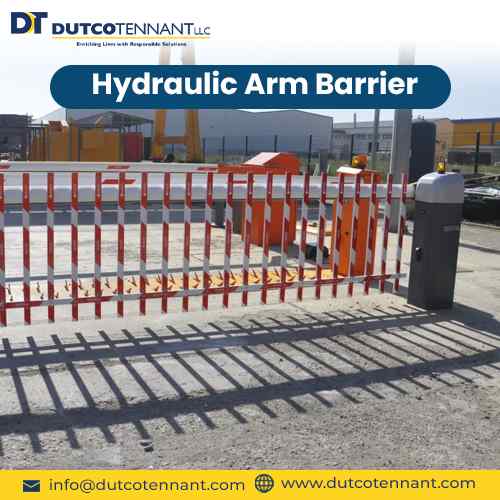
Automatic Barrier Arm Gates for Integrated Access Management
Automatic barrier arm gates can be connected to compatible vehicle identification and access management systems.
For example, a commercial development may use a barrier arm gate connected to an access card reader or ANPR platform to manage authorised vehicle entry.
Magnetic loop detection can complement barrier arm operation by identifying vehicle presence within a designated detection area.
When specifying a magnetic barrier arm system, consultants should verify the drive mechanism, detection technology and control interfaces against the project's requirements.
Hydraulic Arm Barriers vs Electromechanical Arm Barriers
| Feature | Hydraulic Arm Barriers | Electromechanical Arm Barriers |
|---|---|---|
| Operating mechanism | Hydraulic actuation | Electric motor-driven mechanism |
| Movement | Controlled hydraulic movement | Mechanically driven arm movement |
| Operating frequency | Suitable for demanding duty cycles, depending on model | Varies according to motor and duty-cycle specifications |
| Maintenance | Hydraulic and mechanical components | Electrical and mechanical components |
| Typical application | Logistics and industrial facilities | Commercial and residential parking |
| Selection priority | Hydraulic performance and operational frequency | Motor configuration and automation requirements |
Both technologies support regulated vehicle access. The appropriate configuration depends on operational frequency, maintenance requirements and integration compatibility.
Typical applications: Commercial developments, logistics centres, industrial facilities, government buildings and utility infrastructure.
Road Blockers for Reinforced Perimeter Protection
Conventional barrier arms primarily regulate vehicle movement. However, facilities requiring physical protection against vehicle intrusion may require equipment with verified impact resistance.
A road blocker is a physical vehicle restriction system designed to prevent unauthorised vehicle passage at controlled access points.
Road blockers are particularly relevant to facilities where vehicle access management forms part of a broader perimeter security strategy.
Depending on the model, important characteristics include reinforced construction, hydraulic actuation, different mounting configurations and compatibility with central security infrastructure.
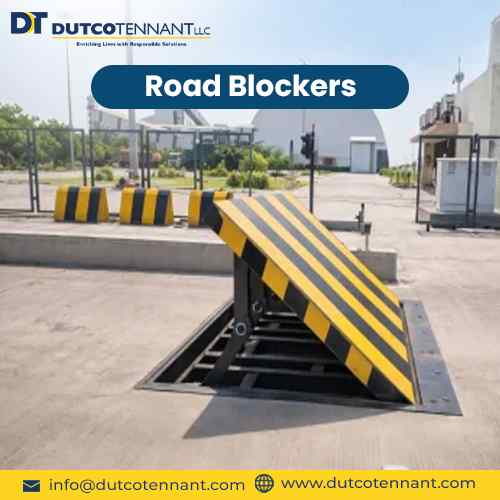
Crash Rated Road Blockers for High-Security Facilities
A crash rated road blocker is tested under specified vehicle impact conditions to establish its protective performance.
Unlike ordinary traffic barriers, crash-rated equipment is evaluated according to defined impact testing criteria.
Relevant certification documentation may reference standards such as IWA 14-1 or legacy K-rating classifications, depending on the product.
The applicable crash rating and test documentation should be verified for the specific model before procurement.
These systems are relevant to critical infrastructure projects, government facilities and other environments with formally assessed vehicle security requirements.
Suggested image alt text: Crash Rated Road Blocker supplier in UAE.
Hydraulic Road Blockers for Automated Vehicle Restriction
A hydraulic road blocker uses a hydraulic actuation mechanism to operate its physical blocking structure.
Hydraulic configurations can be incorporated into compatible automated access control systems, allowing security personnel to manage vehicle passage through authorised control interfaces.
Important selection considerations include operating reliability, maintenance accessibility, environmental suitability and compatibility with the facility's security infrastructure.
Hydraulic road blockers are commonly considered for projects requiring automated physical vehicle restriction.
Surface Mounted Road Blockers for Infrastructure Upgrades
Existing underground utilities and civil infrastructure can influence the feasibility of installing conventional security equipment.
A surface mounted road blocker provides an alternative configuration for projects where extensive foundation excavation is undesirable or restricted.
Its installation suitability depends on the existing surface conditions, structural requirements and manufacturer specifications.
Surface-mounted configurations are particularly relevant to refurbishment projects and existing facilities undergoing security upgrades.
Suggested image alt text: Surface Mounted Road Blocker for vehicle access control.
Crash Rated vs Hydraulic vs Surface Mounted Road Blockers
| Product | Primary characteristic | Main benefit |
|---|---|---|
| Crash Rated Road Blocker | Verified impact performance | Supports specified perimeter protection requirements |
| Hydraulic Road Blocker | Hydraulic actuation | Supports automated vehicle restriction |
| Surface Mounted Road Blocker | Surface-based mounting configuration | Addresses certain civil installation constraints |
These categories are not mutually exclusive. A vehicle road blocker may incorporate hydraulic actuation, surface mounting and crash-rated construction within the same product configuration.
Typical applications: Government establishments, airports, transport infrastructure, industrial developments and selected commercial facilities.
Tyre Killers for Specialised Vehicle Access Restriction
Certain facilities require specialised equipment to prevent prohibited vehicle movement as part of their access control arrangements.
Tyre killers are physical vehicle restriction devices that use tyre-damaging elements to discourage or restrict unauthorised passage.
Unlike conventional gate barriers, these systems present additional operational safety considerations and require professional specification, authorised operation and appropriate safeguards.
Different configurations are available based on their operating mechanism and installation requirements.
Hydraulic Tyre Killers
A hydraulic tyre killer incorporates a hydraulic mechanism for controlled operation.
Hydraulic configurations are relevant to professionally managed security environments requiring coordination with compatible access control infrastructure.
Selection considerations include hydraulic system reliability, environmental protection, maintenance requirements and applicable safety provisions.
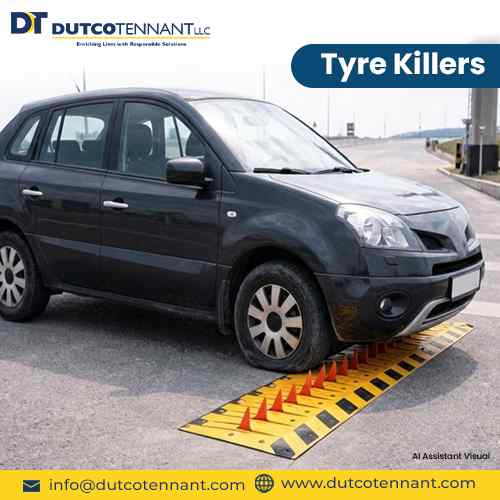
Mechanical Tyre Killers
Mechanical tyre killers use mechanically operated components rather than powered hydraulic actuation.
Their comparatively straightforward mechanical construction distinguishes them from automated configurations.
The suitability of mechanical equipment depends on the facility's approved security procedures, operational requirements and safety assessment.
Suggested image alt text: Mechanical Tyre Killers for vehicle security.
Electromechanical Tyre Killers
Electromechanical tyre killers incorporate electrically driven mechanical components for controlled operation.
Depending on the configuration, these systems can support integration with compatible security management equipment.
Electrical compatibility, mounting requirements and manufacturer-specified safety provisions are important considerations during product selection.
Hydraulic vs Mechanical vs Electromechanical Tyre Killers
| Feature | Hydraulic | Mechanical | Electromechanical |
|---|---|---|---|
| Operating technology | Hydraulic actuation | Mechanical mechanism | Electric motor-driven mechanism |
| Control configuration | Powered operation | Mechanically controlled | Electrically controlled |
| System requirements | Hydraulic components | Mechanical components | Electrical and mechanical components |
| Main selection consideration | Hydraulic reliability | Mechanical integrity | Electrical compatibility |
| Maintenance focus | Hydraulic system | Mechanical assemblies | Motor and control components |
The selection of tyre killers must follow a professional security and safety assessment, applicable regulations and manufacturer requirements.
Hydraulic Arm Barriers vs Road Blockers vs Tyre Killers
Although all three products belong to the gate barriers category, they perform different functions within vehicle access management infrastructure.
| Feature | Hydraulic Arm Barrier | Road Blocker | Tyre Killer |
|---|---|---|---|
| Primary function | Regulates routine vehicle passage | Provides physical vehicle restriction | Restricts prohibited vehicle movement |
| Operating principle | Raising and lowering a barrier arm | Physical blocking structure | Specialised tyre restriction mechanism |
| Main consideration | Traffic management | Verified protective performance | Authorised operation and safety |
| System integration | Vehicle identification and access control | Security management infrastructure | Compatible security controls |
| Installation requirements | Depends on arm assembly and foundations | Depends on mounting and structural requirements | Depends on approved mounting configuration |
These products are complementary rather than direct alternatives. Each addresses a distinct requirement within a professionally designed vehicle access control system.
Vehicle Access Control Solutions for Different Project Environments
Commercial and Mixed-Use Developments
Commercial buildings, shopping centres, hotels and residential developments require organised vehicle access without unnecessarily interrupting everyday operations.
Automatic barrier arm gates can support controlled entry for residents, employees, visitors and authorised service vehicles.
Industrial and Logistics Facilities
Manufacturing plants, warehouses and distribution centres experience regular movement of commercial vehicles.
Hydraulic arm barriers can support structured vehicle access, while additional security equipment may be considered according to the facility's risk assessment.
Government and Critical Infrastructure
Government facilities and critical infrastructure projects require vehicle access equipment selected according to formal security specifications.
Verified product performance, regulatory compliance and compatibility with existing security infrastructure are important procurement considerations.
Airports and Transportation Facilities
Transportation infrastructure requires coordination between security procedures and operational vehicle movement.
Suitable gate barrier systems can support the management of authorised vehicles while maintaining established access control protocols.
Integrating Gate Barriers with Vehicle Access Control Infrastructure
Modern vehicle access control equipment can form part of a wider building security network rather than operating as isolated equipment.
Depending on product compatibility, gate barriers may be integrated with:
- Automatic Number Plate Recognition (ANPR) systems.
- RFID and access card readers.
- Magnetic loop vehicle detectors.
- CCTV monitoring systems.
- Centralised security management platforms.
- Traffic signals and safety detection equipment.
Integration allows authorised personnel to manage vehicle access through coordinated security interfaces.
However, equipment compatibility, safety interlocks and control protocols must be reviewed during system design.
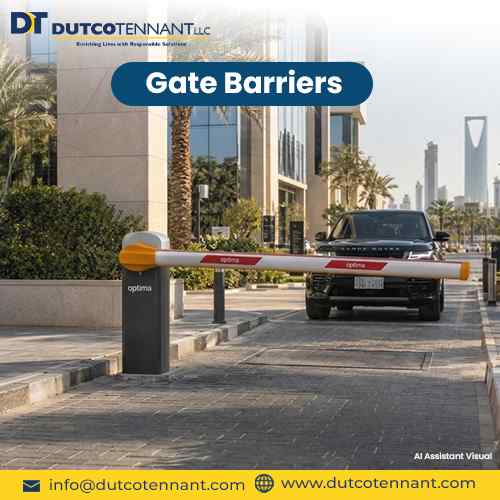
Selecting Gate Barriers for UAE and GCC Projects
Outdoor vehicle access control equipment in the UAE and GCC is frequently exposed to elevated temperatures, dust, humidity and demanding operating schedules.
Selecting suitable equipment requires consideration of both environmental and project-specific requirements.
| Selection factor | What should be considered? |
|---|---|
| Vehicle traffic | Expected traffic volume and operating frequency |
| Security requirements | professionally assessed protection requirements |
| Environmental exposure | Temperature, dust, humidity and corrosion |
| Civil infrastructure | Foundation requirements and existing structural conditions |
| System compatibility | Access control and monitoring interfaces |
| Maintenance | Component accessibility and scheduled servicing |
| Certification | Applicable product-specific testing documentation |
| Operational safety | Safety devices, emergency procedures and authorised operation |
At Dutco Tennant LLC, our gate barrier portfolio addresses different vehicle access management requirements across commercial, industrial, institutional and infrastructure developments throughout the UAE and GCC.
Frequently Asked Questions
What are gate barriers used for?
Gate barriers regulate vehicle passage, manage authorised access and support perimeter security at commercial, industrial and institutional facilities.
What is a hydraulic arm barrier?
A hydraulic arm barrier uses fluid-powered actuation to raise and lower a barrier arm for controlled vehicle access.
What is the difference between an arm barrier and a road blocker?
An arm barrier primarily regulates routine vehicle movement, whereas a road blocker provides physical vehicle restriction. Specific impact resistance depends on the product's tested performance.
Are all road blockers crash rated?
No. Crash-rated performance must be established through applicable testing and verified certification documentation for the particular model.
What types of tyre killers are available?
Common configurations include hydraulic tyre killers, mechanical tyre killers and electromechanical tyre killers.
Can gate barriers integrate with ANPR systems?
Yes. Compatible automatic gate barriers can be connected to ANPR systems and other vehicle identification technologies through suitable control interfaces.
Can gate barriers operate in UAE outdoor conditions?
Yes, provided the selected equipment is rated for the expected operating temperature, environmental exposure and duty-cycle requirements.
Conclusion: Selecting the Right Gate Barrier Technology for Every Facility
Effective vehicle access management depends on selecting equipment that addresses the actual operational and security requirements of a facility.
Hydraulic arm barriers support routine vehicle regulation, road blockers provide physical vehicle restriction, and tyre killers address specialised security requirements.
Understanding the differences between these technologies allows consultants, contractors, security system integrators and facility managers to make informed equipment selection decisions.
Dutco Tennant LLC supplies a comprehensive range of gate barriers and vehicle access control solutions for commercial, industrial, institutional and infrastructure projects across the UAE and GCC.