
Professional Audio Solutions for Commercial Buildings: Products, Features and Applications
Clear communication plays an important role in commercial and institutional buildings. A corporate boardroom requires reliable speech capture, a hotel needs background music across different areas, and an industrial facility depends on announcements being heard in demanding environments.
Although these spaces share a need for effective audio communication, their technical requirements differ considerably.
Room dimensions, acoustic conditions, speaker placement, microphone coverage and connectivity all influence the performance of a professional audio installation. Selecting suitable equipment therefore requires an understanding of how different audio technologies work and where they can be applied.
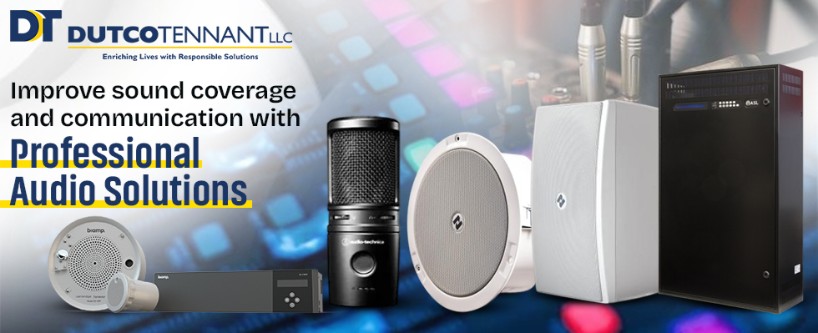
Dutco Tennant LLC supplies a comprehensive portfolio of professional audio solutions across the UAE and GCC, including microphones, amplifiers, audio routers, commercial speakers, discussion systems, sound masking equipment and complete room solutions.
This guide explains the features and applications of these products, highlights the differences between related technologies and explores how they can support commercial and institutional projects.
Professional Audio Solutions for Conference Rooms and Collaborative Workspaces
Conference rooms have evolved into connected environments where participants communicate both in person and remotely.
A small meeting room may need a straightforward microphone and speaker arrangement, while a large boardroom requires audio equipment capable of capturing voices from different seating positions.
Specialised microphone technologies help address these requirements.
Array Microphones for Intelligent Speech Capture
An array microphone uses multiple pickup elements and beamforming technology to capture speech from different positions in boardrooms, conference rooms and hybrid meetings.
Depending on the model, features can include multiple microphone elements, electronically controlled pickup patterns, directional voice capture, integrated signal processing and ceiling or tabletop mounting options.
These capabilities are particularly useful in conference rooms where participants are seated across a large table.
Instead of placing an individual microphone in front of every person, a properly configured array microphone can provide coverage across designated seating areas. Beamforming can also help reduce the pickup of unwanted sound from outside the intended speaking zones.
Ceiling-mounted configurations offer an additional advantage by keeping conference tables free from microphone equipment.
Array microphones are relevant to corporate boardrooms, hybrid meeting rooms, executive offices and training facilities where consistent voice capture is important.

Network Microphones for Connected Audio Infrastructure
A network microphone transmits audio through a compatible digital network, allowing microphone signals to be incorporated into an IP-based audio system.
Depending on the equipment, network microphones may include digital audio interfaces, support for specific audio-over-IP protocols, remote configuration capabilities and integration with compatible audio processing systems.
Their primary advantage is connectivity.
In a corporate headquarters containing multiple meeting rooms, network microphones can form part of a coordinated audio infrastructure rather than relying entirely on separate analogue signal connections.
This can support flexible signal distribution and equipment management when the connected devices and network infrastructure are compatible.
Network microphones are particularly relevant to offices, educational institutions and conference facilities using network-based AV systems.
The Network Microphones range can be considered for professional communication environments requiring digital audio connectivity.

Array Microphones vs Network Microphones
Although both technologies are used in professional conferencing, they are distinguished by different technical characteristics.
| Feature | Array Microphones | Network Microphones |
|---|---|---|
| Primary characteristic | Multiple microphone elements for speech pickup | Digital audio transmission through a network |
| Main capability | Directional pickup and potentially beamforming | Integration with compatible network audio systems |
| Main benefit | Captures speech across different speaking positions | Supports connected audio infrastructure |
| Typical application | Boardrooms and hybrid meeting rooms | Networked conference facilities and corporate offices |
| Selection priority | Pickup coverage and room acoustics | Network protocols and system compatibility |
Important: These categories are not mutually exclusive. An array microphone can also support network audio connectivity, depending on its design.
Complete Room Solutions for Integrated Conferencing
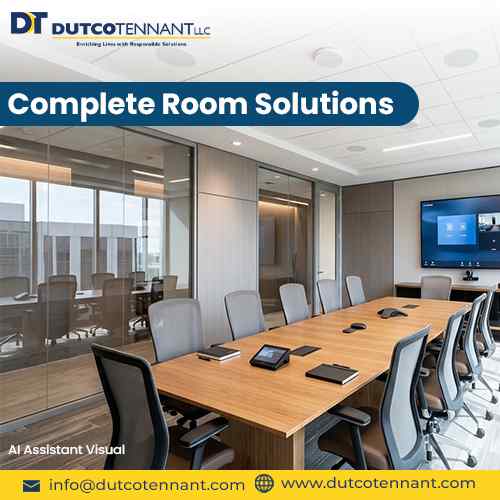
A complete room audio solution combines microphones, speakers and processing equipment for clear communication in conference rooms, boardrooms and collaborative workspaces.
Depending on the configuration, the system may include microphones, speakers, digital signal processing equipment and connections to compatible conferencing platforms.
Important capabilities can include speech capture, audio reproduction, echo cancellation, signal routing and coordinated equipment control.
These functions help address challenges that arise when several audio devices operate within the same room.
For example, a hybrid meeting room must capture local participants while reproducing speech from remote attendees. Without suitable processing and system configuration, audio may suffer from echo, inconsistent levels or poor intelligibility.
A coordinated room solution helps ensure that the selected components operate together according to the room's requirements.
These arrangements are particularly relevant to corporate meeting rooms, executive boardrooms, training centres and collaborative workspaces.
Discussion Systems for Formal Meetings and Conference Facilities
Formal meetings often require more structured microphone access than ordinary collaboration rooms.
Government councils, institutional committees and corporate boards may need individual speaking positions and controlled microphone operation.
Wired and Wireless Discussion Systems
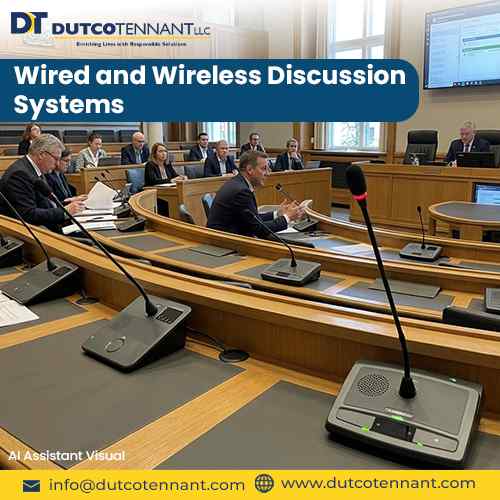
A discussion system is a specialised conferencing arrangement that uses participant microphone units and associated control equipment to manage communication during multi-person meetings.
Depending on the system, features may include individual microphone activation, central control, participant microphone units and wired or wireless connectivity.
These capabilities support organised discussions where several participants need access to microphones.
In a council chamber, individual microphone units allow participants to speak from designated positions. A compatible control system can manage microphone operation according to the meeting format.
Discussion systems are commonly considered for government facilities, corporate boardrooms, council chambers and institutional conference rooms.
The Wired and Wireless Discussion Systems range provides options for structured meeting environments.
Wired vs Wireless Discussion Systems
| Feature | Wired Discussion Systems | Wireless Discussion Systems |
|---|---|---|
| Connectivity | Physical cabling | Wireless transmission |
| Installation | Suitable for fixed seating arrangements | Suitable for flexible room layouts |
| Equipment mobility | Limited by cable locations | Easier to reposition |
| Main consideration | Cable routing and permanent installation | Radio coordination and power management |
| Typical application | Council chambers and permanent boardrooms | Multi-purpose conference rooms |
Wired systems are often practical for permanent meeting facilities, while wireless configurations provide greater flexibility when seating arrangements change.
Audio Amplification and Routing for Commercial Buildings
Large commercial developments frequently require sound to be distributed across multiple areas.
A hotel may need music in its lobby, announcements in circulation areas and separate audio arrangements for conference facilities.
Audio routers and amplifiers help manage these requirements.
Audio Routers for Multi-Zone Sound Distribution
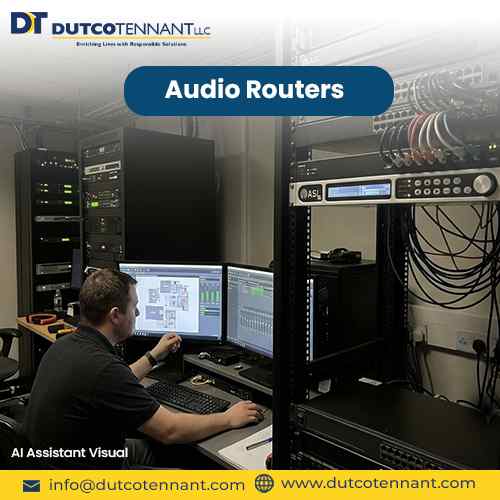
An audio router directs audio signals from selected sources to designated destinations within a sound system.
Depending on the model, features may include multiple inputs and outputs, configurable signal routing, digital or analogue audio interfaces and compatibility with external control equipment.
These capabilities allow different audio signals to be distributed to different areas.
For example, a hotel can use routing equipment to direct background music towards the lobby while sending a separate audio source to its conference facilities.
Audio routers are relevant to hotels, shopping centres, corporate headquarters, educational campuses and other multi-zone commercial environments.
Power Amplifiers for Professional Sound Reinforcement
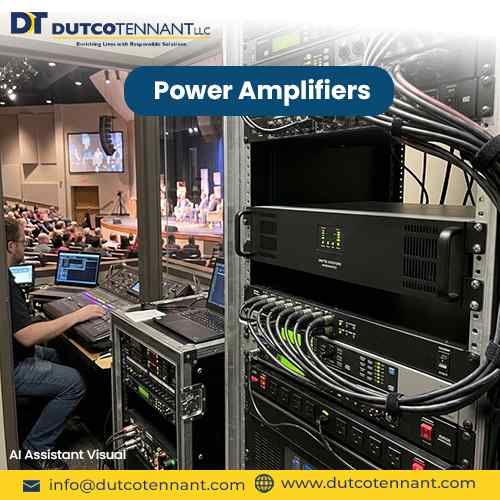
A power amplifier increases the electrical power of an audio signal so that compatible passive loudspeakers can reproduce sound.
Important characteristics include amplifier output power, channel configuration, supported speaker impedance and protection features, depending on the model.
Power amplifiers are essential components in many professional sound reinforcement systems.
In an auditorium, they provide the electrical output required by compatible speakers used for presentations and events. Commercial buildings may also use amplification equipment to operate distributed speaker systems.
Selecting the appropriate amplifier helps ensure that connected speakers receive suitable power for their intended operating conditions.
Network Amplifiers for IP-Based Audio Systems
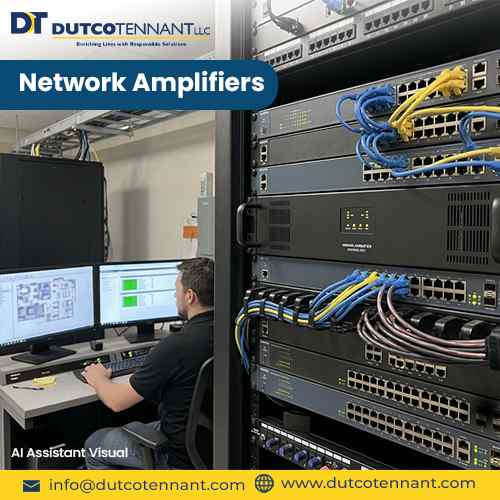
A network amplifier combines digital audio connectivity with speaker amplification for integrated sound distribution across commercial buildings and institutional facilities.
Depending on the model, features may include multiple amplification channels, digital audio networking, remote configuration and equipment monitoring.
These capabilities are particularly useful in commercial buildings with connected audio infrastructure.
For example, a corporate headquarters may use network amplifiers as part of a system serving different floors, meeting facilities and common areas.
The technology can support coordinated audio distribution when the network and connected devices are properly configured.
Power Amplifiers vs Network Amplifiers vs Audio Routers
| Product | Primary function | Main difference | Typical application |
|---|---|---|---|
| Power Amplifier | Drives compatible passive speakers | Provides electrical amplification | Auditoriums, speaker installations |
| Network Amplifier | Amplifies audio received through compatible network connections | Combines amplification with network connectivity | Connected commercial buildings |
| Audio Router | Directs signals between audio sources and destinations | Manages signal distribution | Hotels, multi-zone facilities |
These products are complementary rather than direct alternatives. A large commercial audio system may require routing equipment alongside suitable amplifiers.
Commercial Speakers for Different Acoustic Environments
Commercial speakers are available in several configurations because sound distribution requirements vary between spaces.
A ceiling speaker designed for background music in a hotel lobby serves a different purpose from a horn speaker used for industrial announcements.
Understanding their design and operating characteristics helps identify suitable equipment for each application.
Ceiling Speakers for Discreet Sound Distribution
A ceiling speaker is a discreet overhead loudspeakers designed for distributed background music, announcements and general audio reproduction in offices, hotels, retail spaces and commercial interiors.
Depending on the model, features may include flush-mount installation, wide sound dispersion, different power ratings and compatibility with distributed audio systems.
Their overhead placement helps preserve wall and floor space while allowing multiple speakers to cover an occupied area.
In hotels, ceiling speakers are commonly used for background music in lobbies and circulation areas. Offices and retail environments may use them for announcements and general audio reproduction.

Wall Mount Speakers for Directed Audio Coverage
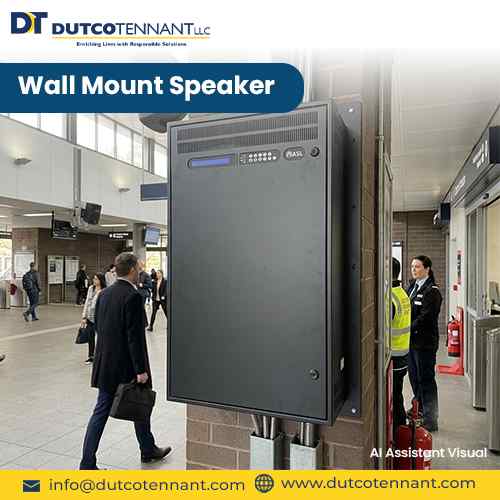
A wall mount speaker is a loudspeaker providing direct sound coverage for background music, announcements and presentations in restaurants, retail stores, offices and training rooms.
Depending on its design, features may include adjustable mounting arrangements, directional coverage, different driver configurations and a range of power ratings.
Wall mounting provides flexibility where ceiling installation is unsuitable or where sound needs to be directed towards particular listening positions.
Restaurants, training rooms, retail spaces and commercial corridors are common applications.
Cabinet Speakers for Presentation and Event Spaces
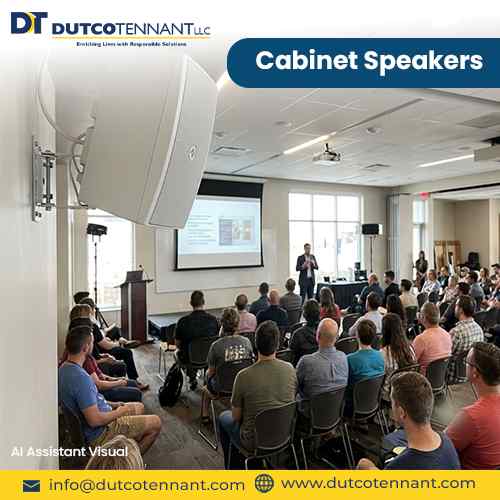
A cabinet speaker contains one or more loudspeaker drivers within an enclosure designed to support their acoustic performance.
Cabinet design influences frequency response, sound coverage and output characteristics.
Depending on the model, cabinet speakers may provide different driver configurations, power handling capabilities, dispersion patterns and mounting options.
These characteristics make them relevant to presentation halls, training facilities and professional sound reinforcement applications.
In a multi-purpose hall, suitable cabinet speakers can reproduce speech and multimedia audio for presentations and events.
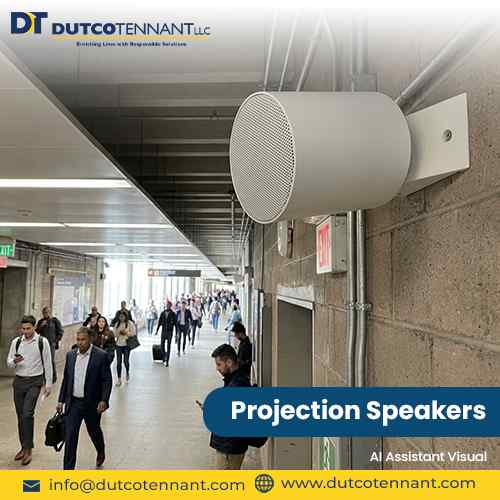
Projection Speakers for Corridors and Circulation Areas
A projection speaker is a directional loudspeakers designed to distribute announcements and public address audio across corridors, passageways, transport facilities and industrial environments.
Depending on the model, features may include directional sound dispersion, surface-mount installation and compatibility with public address systems.
Their acoustic characteristics can be useful in corridors, passageways and transport facilities where announcements need to reach people along designated routes.
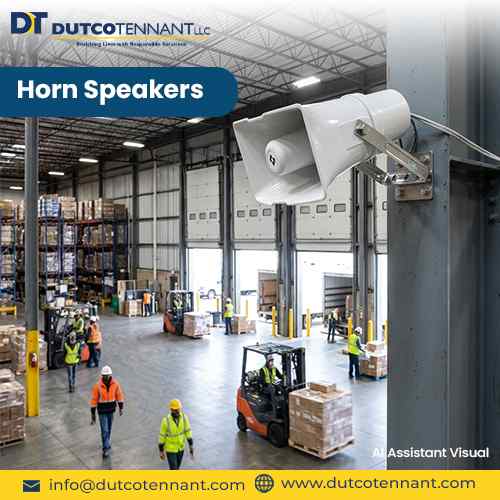
Horn Speakers for Industrial and Outdoor Communication
A horn speaker is a high-efficiency directional loudspeaker designed for clear public address announcements in warehouses, factories, transport facilities and demanding outdoor environments.
Typical characteristics include controlled sound dispersion and efficient sound projection. Environmental protection and output specifications vary by model.
Horn speakers are commonly used in industrial public address applications where announcements must remain intelligible despite background noise.
Warehouses, manufacturing facilities, loading areas and selected outdoor operational spaces are common applications.
For UAE and GCC installations, outdoor equipment must be selected with appropriate protection against heat, dust, humidity and corrosion.
Comparing Commercial Speaker Types
| Speaker Type | Main characteristic | Suitable applications |
|---|---|---|
| Ceiling Speaker | Overhead installation and distributed coverage | Offices, hotels, retail interiors |
| Wall Mount Speaker | Wall-mounted sound distribution | Restaurants, corridors, training rooms |
| Cabinet Speaker | Enclosed speaker design for selected sound reinforcement requirements | Presentation halls, event spaces |
| Projection Speaker | Directional sound projection | Corridors, passageways, public address |
| Horn Speaker | Efficient, directed sound output | Industrial facilities, warehouses, outdoor areas |
The final selection depends on the required coverage, acoustic environment, mounting arrangement and technical specifications.
Wired and Wireless Microphone Systems for Presentations and Events
Different speaking arrangements require different microphone configurations.
A fixed lectern may benefit from a direct wired connection, while a trainer moving around a room requires greater mobility.
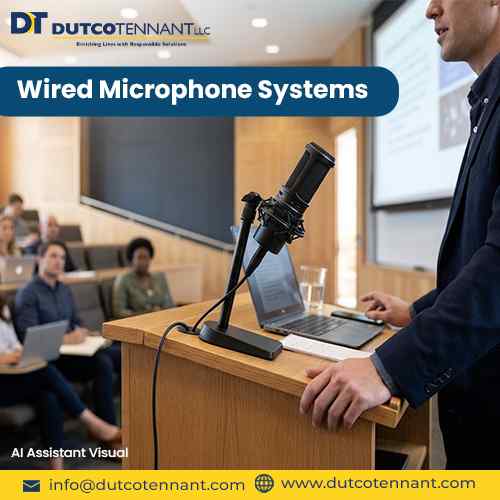
Wired Microphone Systems for Fixed Speaking Positions
A wired microphone system consists of professional microphones with direct cable connections for dependable speech capture at lecterns, presentation desks, conference rooms and educational facilities.
Depending on the microphone, features may include directional pickup patterns, professional audio connectors and different mounting configurations.
A direct cable connection avoids the need for wireless frequency coordination and transmitter batteries.
This makes wired microphones practical for fixed applications such as lecture podiums, conference lecterns and presentation desks.
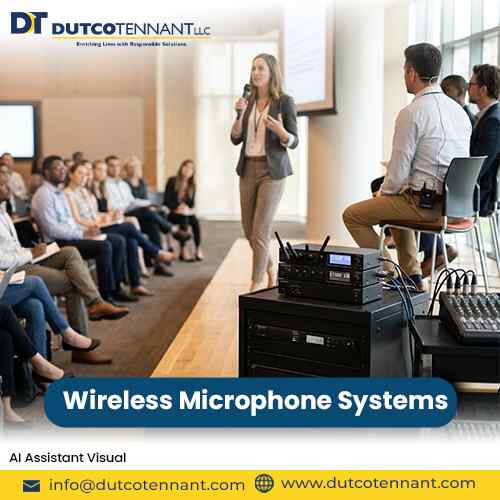
Wireless Microphone Systems for Presenter Mobility
A wireless microphone system transmits audio from a microphone or transmitter to a compatible receiver without a direct audio cable.
Typical configurations include handheld microphones and bodypack transmitters, depending on the system.
Features may include selectable operating channels, receiver controls and battery-powered operation.
Wireless microphones allow presenters, trainers and event speakers to move more freely.
They are commonly used in conferences, training sessions, educational facilities and professional events.
Wireless frequency planning, operating range and receiver positioning must be considered during system selection.
Wired vs Wireless Microphone Systems
| Feature | Wired Microphones | Wireless Microphones |
|---|---|---|
| Audio connection | Physical cable | Wireless transmission to a receiver |
| Mobility | Limited by cable length | Greater freedom of movement |
| Power considerations | Depends on microphone type | Transmitter battery or power management |
| Installation | Suitable for fixed positions | Suitable for changing speaking positions |
| Typical applications | Lecterns, fixed presentations | Training, events, mobile presenters |
Both technologies can operate within the same audio system when compatible equipment is used.
Sound Masking Systems for Acoustic Privacy
Not every audio challenge involves increasing sound levels.
In open-plan offices, conversations from nearby workstations can create distractions and reduce speech privacy.
Sound Masking for Shared Workspaces
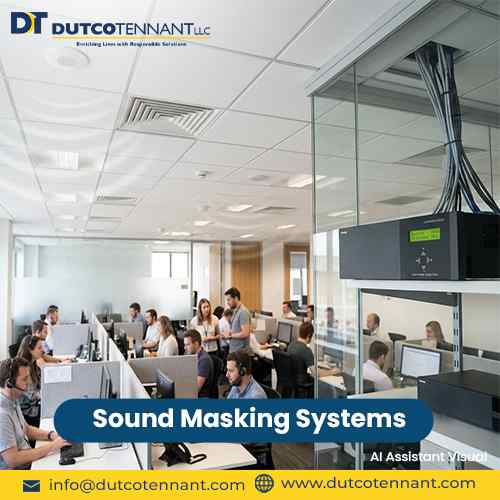
A sound masking system introduces controlled background sound to reduce the intelligibility of surrounding conversations.
A typical system uses sound generation and control equipment together with distributed speakers.
Important capabilities include adjustable masking levels, frequency shaping and sound distribution across designated areas.
Unlike soundproofing, sound masking does not prevent sound from travelling between spaces. Instead, it changes the acoustic background so that nearby conversations become less understandable.
In open-plan offices, this can help reduce distractions caused by conversations at neighbouring workstations.
Sound masking may also contribute to acoustic privacy strategies in healthcare administrative areas, shared workplaces and institutional facilities.
How Professional Audio Equipment Works Together in a Commercial Project
Consider a corporate office with a boardroom, training facility, reception area and shared workspace.
The boardroom may use array microphones for multi-participant speech capture, supported by compatible audio processing and speakers.
The training facility may incorporate wireless microphones to allow presenters to move freely, while suitable amplifiers and speakers reproduce audio for participants.
The reception area may use ceiling speakers for background music, with an audio router directing the appropriate signal to that zone.
Shared workspaces may benefit from sound masking equipment to reduce speech distractions.
Where the building includes compatible network audio infrastructure, network microphones and amplifiers may also be incorporated.
This illustrative example demonstrates how different products can address specific requirements while operating as part of a coordinated audio arrangement.
Choosing Audio Equipment for UAE and GCC Projects
Professional audio equipment should be selected according to the technical requirements of each installation.
Room dimensions, ceiling height, acoustic conditions and background noise influence microphone pickup and speaker coverage.
The intended application determines whether the system requires conferencing equipment, sound reinforcement, background music distribution or public address capabilities.
Connectivity is another important consideration. Network audio equipment must be compatible with the existing infrastructure and connected devices.
Outdoor installations require particular attention to operating temperatures, dust exposure, humidity and environmental protection.
Consultants and contractors should also review equipment specifications, mounting requirements, relevant standards and future expansion needs before finalising product selections.
Professional Audio Equipment Supplied by Dutco Tennant LLC
Commercial and institutional projects across the UAE and GCC require audio technologies suited to different communication environments.
Corporate offices need conferencing equipment, hotels require sound distribution across multiple areas, educational institutions depend on speech reinforcement, and industrial facilities require suitable public address equipment.
Dutco Tennant LLC supplies a broad portfolio of professional audio products covering these requirements.
The range includes microphones, discussion systems, audio routers, amplifiers, commercial speakers, sound masking equipment and complete room solutions.
For consultants, AV integrators, contractors and procurement teams, the portfolio provides access to complementary product categories that can be evaluated according to project specifications.
Frequently Asked Questions
What equipment is required for a professional conference room?
A professional conference room may require microphones, speakers, audio processing equipment and compatible conferencing connections. The specific configuration depends on room dimensions, participant capacity and communication requirements.
What is the difference between array microphones and network microphones?
Array microphones are characterised by multiple microphone elements and may use beamforming for directional speech capture. Network microphones are distinguished by digital audio connectivity. Some products incorporate both technologies.
What is the difference between power amplifiers and network amplifiers?
Power amplifiers provide electrical amplification for compatible passive speakers. Network amplifiers combine amplification with connectivity to supported digital audio networks.
Which speaker type is best for commercial buildings?
The appropriate speaker depends on the application. Ceiling speakers are commonly used for distributed background audio, cabinet speakers for selected sound reinforcement applications and horn speakers for industrial announcements.
Are wired or wireless discussion systems better for conference rooms?
Wired systems are often practical for permanent seating arrangements, while wireless systems provide flexibility in rooms where participant positions change.
Can wired and wireless microphones operate together?
Yes. Compatible wired and wireless microphones can be connected to the same audio system through suitable processing or mixing equipment.
What is the purpose of sound masking?
Sound masking introduces controlled background sound to reduce speech intelligibility and help manage acoustic privacy in shared environments.
Conclusion: Selecting the Right Audio Technology for Every Space
Professional audio systems perform best when equipment is selected according to the communication requirements of the space.
Microphones capture speech, amplifiers provide power to compatible speakers, audio routers manage signal distribution and different loudspeaker designs address specific acoustic environments.
Discussion systems support structured meetings, while sound masking helps manage speech privacy in shared workspaces.
Understanding the features and differences between these products allows consultants, contractors and system integrators to make more informed equipment decisions.
Dutco Tennant LLC supplies a comprehensive range of professional audio solutions for commercial, institutional and infrastructure projects across the UAE and GCC.