Power Without Interruption: Explore Delta UPS Solutions with Us at Middle East Energy 2026
For a modern business, even a short power interruption can have consequences. Servers can go offline, network connectivity can be disrupted, critical processes may stop, and sensitive electronic equipment can be exposed to unstable power conditions.
The challenge is therefore not simply having backup power. It is building a power protection system that matches the importance, size and operating requirements of the connected load.
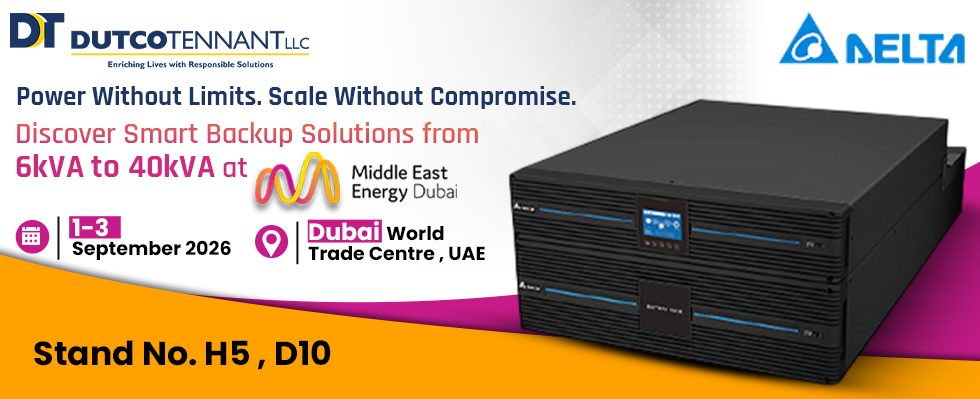
At Middle East Energy 2026, we will showcase two Delta solutions that demonstrate how uninterrupted power protection can be designed for different levels of demand: the Delta Amplon RT 6 kVA with external battery cabinet and the Delta Ultron HPH Gen2 40 kVA with internal batteries.
Join us from 1–3 September 2026 at the Dubai World Trade Centre, UAE, to explore these solutions and discuss how the right UPS architecture can strengthen power continuity across business-critical applications.
What Happens When Critical Equipment Loses Power?
Power problems are not limited to long blackouts. Voltage fluctuations, unstable supply conditions and short interruptions can also affect sensitive electrical and electronic equipment.
For an office IT environment, this could mean interrupted network access or server downtime. In a data centre, the impact can extend across multiple systems and applications. In industrial and commercial environments, an interruption may affect communication, monitoring, automation or other essential operations.
An online UPS creates an additional layer of protection between the incoming electrical supply and the critical load.
The objective is straightforward: keep essential equipment supplied with stable power when the incoming source cannot.
Start with the Load, Not the UPS
Selecting a UPS simply because it has a higher kVA rating does not necessarily result in a better backup system.
A more effective approach begins with understanding the load.
How much equipment needs protection? How long should it remain operational during an interruption? Is the electrical system single-phase or three-phase? Is additional equipment likely to be added later? Is the priority longer battery runtime, a smaller footprint or greater redundancy?
These questions determine the type of UPS architecture that makes sense.
The two Delta systems we are highlighting at MEE 2026 demonstrate how those requirements can change as critical loads grow.
Delta Amplon RT 6 kVA: Online Protection in a Compact Format
For smaller critical environments, the Delta Amplon RT 6 kVA provides 6 kVA / 6 kW of online power protection.
It uses a double-conversion online UPS architecture, continuously conditioning the power supplied to connected equipment. This makes it suitable for sensitive loads where power quality and continuity are important.
The RT Series is particularly relevant for applications such as server rooms, network infrastructure, communication equipment and business-critical IT systems.
Its compact rack/tower design also provides installation flexibility where space is limited.
Extending Runtime with an External Battery Cabinet
The amount of battery backup required can vary significantly between facilities.
Some businesses need only enough time for an alternative power source to become available. Others need a longer period to maintain operations or perform a controlled shutdown.
The Delta RT Series can be paired with external battery cabinets, allowing backup time to be configured according to the application.
This creates an important advantage for growing businesses. If runtime requirements increase, the battery strategy can be reviewed without necessarily changing the entire UPS architecture.
It also allows the UPS and battery installation to be planned separately according to available space and operational requirements.
Efficiency for Equipment That Never Stops
A UPS protecting critical systems may operate continuously, making energy efficiency an important consideration over the life of the equipment.
The Delta Amplon RT Series offers high-efficiency operation, including an ECO mode for applications where additional energy savings are required.
Lower UPS losses can mean less wasted energy and reduced heat generation, which is particularly relevant in server rooms and IT environments where cooling already represents a significant operational requirement.
The RT Series can also support parallel configurations, providing an option for projects where future capacity or redundancy needs to be considered.
When 6 kVA Is No Longer Enough
As an organisation grows, the nature of its critical load can change.
A small server environment may expand into multiple racks. More network infrastructure may be added. Business applications may become increasingly dependent on continuous IT availability. A facility may also move from single-phase loads to a larger three-phase power architecture.
At this point, simply adding battery capacity is not enough. The UPS itself needs to move to a different scale.
This is where the Delta Ultron HPH Gen2 40 kVA becomes relevant.
Delta HPH Gen2 40 kVA: Taking Power Protection to the Next Level
The Delta Ultron HPH Gen2 40 kVA is designed for larger three-phase critical-power applications and delivers 40 kVA / 40 kW capacity.
It is suited to environments such as small and medium data centres, IT infrastructure, communication facilities and other applications where a higher level of power availability is required.
While the RT 6 kVA addresses compact critical loads, the HPH Gen2 provides the capacity and architecture needed when the protected infrastructure becomes larger and more complex.
This gives businesses a path from smaller online UPS protection towards a more comprehensive critical-power system.
Why Choose an Internal Battery Configuration?
The HPH Gen2 40 kVA configuration we will highlight features an internal battery system.
Integrating batteries within the UPS cabinet can be particularly useful when floor space is limited or when a cleaner, consolidated installation is preferred.
It reduces the need for a separate external battery enclosure where the required backup time can be achieved using the internal configuration.
For server rooms, commercial buildings and smaller data centres, this can simplify the physical layout of the backup-power system.
External batteries, however, remain valuable when longer runtime is the priority. The right decision therefore depends on whether the project places greater importance on runtime, footprint, flexibility or future expansion.
Scalability Is About More Than Adding Batteries
A genuinely scalable UPS strategy considers both runtime and power capacity.
Delta's RT and HPH Gen2 platforms support configurations that allow organisations to plan for expansion and redundancy.
This is particularly important when designing critical infrastructure because the load installed today may not represent the load the facility will have several years from now.
Planning for future capacity at the beginning of the project can make later expansion more manageable and reduce the risk of the backup system becoming a limitation as the business grows.
RT 6 kVA or HPH Gen2 40 kVA: Where Does Each Fit?
The two systems solve different power-protection requirements.
The Amplon RT 6 kVA is a compact choice for smaller critical loads where double-conversion online protection, flexible installation and external battery expansion are priorities.
The Ultron HPH Gen2 40 kVA addresses larger three-phase loads where greater power capacity, an integrated battery option and higher-level critical-power protection are required.
The choice between them should therefore be based on the actual electrical and operational requirements rather than simply comparing their capacity.
For some projects, the priority will be longer runtime. For others, it may be physical footprint, redundancy, efficiency or the ability to expand as the facility grows.
A Closer Look at Your Power Backup Strategy at MEE 2026
Middle East Energy provides an ideal setting to move beyond UPS specifications and look at the complete backup-power requirement.
At our stand, we will discuss how the Delta RT 6 kVA with external battery cabinet and HPH Gen2 40 kVA with internal batteries address different critical-power scenarios.
If you have an upcoming project, we encourage you to discuss your connected load, required backup time, available space, electrical configuration and future expansion plans with our team.
These details can help determine whether your application needs a compact online UPS, extended battery runtime, an integrated battery system or a higher-capacity scalable solution.
Keep Your Critical Operations Powered
The right UPS is not simply an emergency power source. It forms part of a wider strategy for protecting critical equipment and maintaining business continuity when incoming power becomes unreliable.
With solutions ranging from the compact Amplon RT 6 kVA to the higher-capacity Ultron HPH Gen2 40 kVA, Delta provides options for different stages of critical-power infrastructure.
Get to know more and Meet us at Middle East Energy 2026, from 1–3 September 2026 at the Dubai World Trade Centre, UAE Hall -5 StaLL D10, to explore these systems and discuss the right power backup strategy for your application.
Whether you are protecting a server room, expanding a data centre or strengthening the resilience of a commercial or industrial facility, we look forward to helping you evaluate a solution that can support both your current requirements and future growth.