



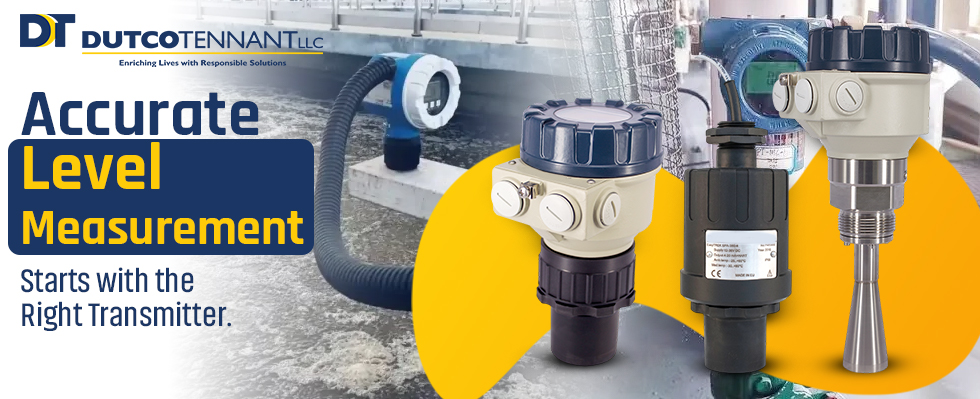
Level Measurement Compared: Radar vs. Ultrasonic vs. Hydrostatic Transmitters
Selecting a level transmitter becomes easier when the application is defined before the sensing method. A process tank, borehole, wastewater wet well and open channel can have similar measuring ranges, yet expose an instrument to very different surfaces, vapours, access limits and maintenance conditions.
Radar, ultrasonic and hydrostatic instruments all provide continuous level data. Radar and ultrasonic devices observe the surface from above, while a hydrostatic probe reads the pressure created by the liquid column from below. Application conditions determine the better starting point.
Storage and process tanks
Tanks often give project teams the widest choice. A non-contact radar sensor sends microwave signals towards the product and calculates distance from the returning reflection. Dutco Tennant's 25 GHz K-band range has a published span of 0.2 to 23 metres, accuracy of ±3 mm, 4-20 mA output and HART communication.
Radar level measurement is well suited to vessels with changing process temperature or pressure. A narrow beam can help where internal fittings restrict the clear measuring path. Engineers still need to coordinate the antenna, nozzle, process connection and mounting position with the vessel geometry and the product's reflective properties.
An ultrasonic transmitter can suit open or atmospheric tanks where the sound path remains clear. The available range includes compact and remote-mounted arrangements, measuring distances up to 20 metres and options for 4-20 mA, HART and Modbus. Temperature compensation supports stable operation, although vapour composition, foam, condensation, turbulence and obstructions can weaken or redirect the echo.
Hydrostatic measurement is another option for liquid tanks when an immersed probe is acceptable. It avoids reliance on a surface echo, but the wetted materials, cable and diaphragm must suit the stored liquid. Density also needs a stable or compensated basis because the indicated level is calculated from pressure.
Wells and reservoirs
Deep wells, boreholes and reservoirs often favour a submersible hydrostatic sensor. The probe is lowered near the base, where pressure rises with the height of liquid above it. A vented cable can reference atmospheric pressure, helping the output represent the liquid head instead of barometric variation.
Surface foam, vapour and floating debris do not interrupt this pressure-based measuring path. The specification should confirm maximum submergence, cable length, probe diameter, housing material and cable-jacket compatibility. Retrieval arrangements are equally important because the probe and cable may need to be lifted for inspection.
Radar or ultrasonic measurement may still be considered where secure top mounting and a clear view of the water surface are available. Open reservoirs also expose above-surface instruments to heat, condensation and weather, so enclosure selection and mounting protection require review.
Wastewater wet wells and sumps
Wet wells combine changing levels with turbulence, foam, suspended solids, floating material and difficult access. No single method suits every installation.
A top-mounted radar sensor avoids contact with wastewater and can reduce the influence of changing air temperature or vapour composition. Its beam must avoid inlet streams, ladders, pumps and other structures that could produce false echoes. The mounting point should also remain accessible for commissioning and inspection.
Ultrasonic measurement provides another non-contact option for sumps and treatment applications when the surface returns a clear acoustic echo. Built-in filtering can distinguish the product surface from some obstructions, but persistent foam, condensation or heavy turbulence should be assessed before selection.
A hydrostatic submersible sensor can maintain a reading when surface conditions are difficult. Direct exposure changes the maintenance plan: the diaphragm may collect deposits, the suspended cable needs protection from abrasion, and all wetted components must be compatible with the wastewater.
Open channels, weirs and flumes
Ultrasonic instruments can be configured for open-channel flow applications where liquid height over a standard weir or through a flume is used to calculate flow. The sensor is mounted above the channel, clear of the liquid, and requires an unobstructed path to the measuring point.
The civil structure and sensor position must be coordinated. The programmed weir or flume profile, upstream measuring location, dead zone and expected maximum level all affect the result. Wind, solar heating, condensation and surface turbulence also deserve attention in outdoor installations.
Hydrostatic pressure can provide level or head measurement in open channels when a submerged installation suits the site. It avoids an overhead sound path, although sediment, debris, density, cable routing and access for cleaning become important.
Complete the specification at site level
The measuring-point schedule should record:
- Minimum and maximum operating level, required accuracy and response time;
- Tank, well or channel geometry, including internal fittings and flow patterns;
- Medium properties such as density, corrosiveness, solids content and build-up tendency;
- Surface conditions, process temperature and pressure, vapour, dust and condensation;
- Output, communications, display and integration with PLC, DCS or SCADA systems;
- Mounting, enclosure, power, cable routing and safe maintenance access; and
- Alarm, pump-control, calibration and independent overfill-protection requirements.
Published measuring range alone does not confirm application performance. Radar needs a suitable reflection and antenna arrangement. Ultrasonic measurement needs adequate echo quality and the correct blanking distance. Hydrostatic measurement needs the correct density basis, compatible wetted parts and a protected atmospheric reference where a vented design is used.
Lifecycle cost follows the same application details. Non-contact faces may need cleaning and retained commissioning parameters, while immersed probes add cable, vent and diaphragm checks. Dutco Tennant can help project teams review these conditions across radar, ultrasonic and hydrostatic options. Accurate results begin with a specification that reflects the actual installation and selects the right level transmitter for its operating environment.