



Top Benefits of GNSS Smart Antennas in Modern Surveying and Mapping
In high-stakes industries such as construction, oil and gas, and urban planning, the answer is: millions of dollars and months of delay. The global demand for centimetre-level spatial accuracy has never been greater, yet many field teams are still relying on positioning technology that simply cannot deliver it.
The problem is systemic. Traditional GPS-only receivers, manual levelling workflows, and post-processing pipelines introduce cumulative errors that compound across large-scale projects.
Industries most affected include:
- Construction and civil engineering, where misaligned foundations or road alignments trigger costly structural corrections
- Mining and quarrying, where volume calculation errors lead to revenue losses
- Agriculture and precision farming, where GPS drift reduces yield optimisation ROI
- Utilities and pipeline mapping, where inaccurate as-built data creates long-term maintenance liabilities
- Urban planning and cadastral mapping, where boundary inaccuracies create legal disputes
The GS05 GNSS Smart Antenna: Precision Engineered for the Modern Field
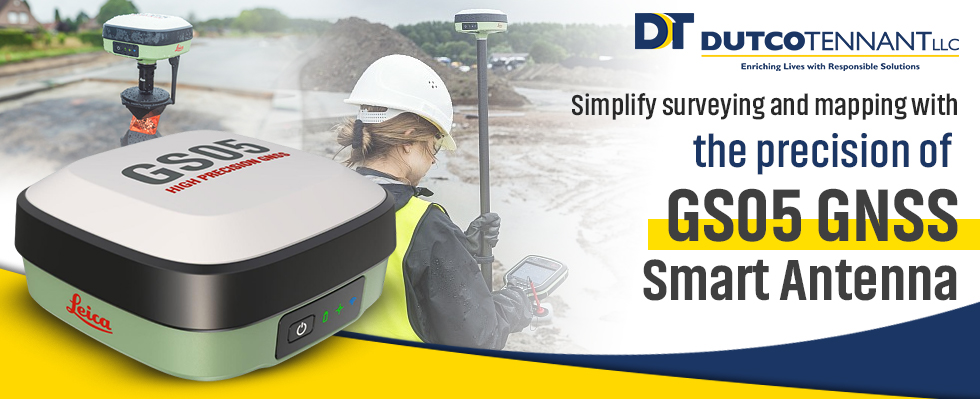
The GS05 GNSS Smart Antenna is a compact, fully integrated GNSS receiver designed to address the core challenges of modern surveying. Unlike conventional setups that require separate base stations, data controllers, and complex cabling, the GS05 combines all critical positioning components into a single, lightweight unit that mounts directly onto a survey pole.
At its core, the GS05 is a multi-constellation, multi-frequency GNSS receiver that simultaneously tracks signals from GPS, GLONASS, BeiDou, Galileo, and QZSS satellite systems. This broad constellation coverage dramatically improves signal availability in challenging environments, such as urban canyons, forest canopies, and near tall structures, where single-constellation receivers routinely fail to maintain fix.
What makes the GS05 particularly effective is its integrated IMU (Inertial Measurement Unit) tilt compensation. Traditional workflows require surveyors to carefully level their pole before every observation, a time-consuming step that introduces human error. The GS05 eliminates this requirement entirely, enabling accurate measurements even when the pole is tilted and reducing the time per point from minutes to seconds.
Connectivity is equally advanced. The GS05 supports Bluetooth, Wi-Fi, and integrated cellular modems, enabling seamless integration with RTK GPS base station networks and GNSS RTK systems via NTRIP correction streams. Combined with its open data protocol compatibility, the GS05 works natively with leading GNSS controllers and field software platforms, making it the ideal centrepiece of a complete GNSS solution for modern survey crews.
Key Features and Technical Advantages
- Multi-Constellation, Multi-Frequency Reception – Tracks all major GNSS constellations for reliable positioning in challenging environments. Multi-frequency support reduces errors and enables RTK fix in under 10 seconds.
- Sub-Centimetre RTK Accuracy – Delivers high-precision results with horizontal accuracy up to 8 mm + 0.5 ppm and vertical accuracy of 15 mm + 0.5 ppm, ideal for cadastral, BIM, and monitoring applications.
- Integrated IMU Tilt Compensation – Allows accurate measurements with pole tilt up to 30 degrees, eliminating the need for levelling and significantly improving field efficiency.
- Rugged, Field-Ready Design – IP67-rated for durability in harsh conditions. Lightweight design and long battery life support extended field operations.
- Seamless GNSS Base Station Integration – Works as both rover and base station component, supporting NTRIP and VRS networks for real-time, high-accuracy positioning without complex setup.
Comparison: Traditional Solution vs GS05 GNSS Smart Antenna
| Feature | Traditional Solutions | GS05 GNSS Smart Antenna |
|---|---|---|
| Positioning Accuracy | 30–100 cm (standalone GPS) | Sub-centimetre RTK accuracy |
| Satellite Systems | GPS only or dual-constellation | All major constellations (GPS, GLONASS, BeiDou, Galileo) |
| Tilt Compensation | Not available | Built-in IMU tilt sensor — no levelling needed |
| Connectivity | Cable or single-band radio | Multi-band, Bluetooth, Wi-Fi, cellular |
| Data Processing | Post-processing required | Real-time RTK with field corrections |
| Field Setup Time | 15–30 minutes | Under 5 minutes |
| Integration | Limited software compatibility | Open protocol, GNSS controller compatible |
| Durability | IP54 or lower | IP67 dust/waterproof rated |
Real-World Applications Across Industries
- Land Surveying and Cadastral Mapping – Reduces field time per parcel with tilt compensation and fast RTK, enabling single-operator efficiency.
- Construction and Infrastructure – Supports machine control, setting-out, and as-built verification with real-time coordination across teams.
- Precision Agriculture – Enables accurate field mapping, drainage planning, and variable rate applications with reliable GNSS performance.
- Oil, Gas, and Utilities – Delivers centimetre-level accuracy for pipeline and utility surveys, ensuring compliance and reducing future risks.
- Topographic and Hydrographic Surveys – Maintains strong signal and real-time integration in coastal and water-based environments.
Benefits and Return on Investment
The business case for adopting the GS05 as the centrepiece of a GNSS solution extends well beyond accuracy. Field operations teams across the Middle East and globally report measurable ROI across multiple dimensions:
- Reduced labour costs: Tilt compensation and rapid RTK fix enable single-operator workflows, cutting crew costs on compatible projects by up to 50%.
- Faster project delivery: Elimination of manual levelling and reduced re-observation rates translate directly to faster data collection typically 30–50% more points per field day.
- Lower total cost of ownership: The GS05's integrated design eliminates separate antenna, receiver, and radio components, reducing equipment inventory, calibration requirements, and failure points.
- Improved data quality: Real-time RTK positioning with network corrections reduces post-processing time and virtually eliminates the blunder rates associated with post-processed static survey workflows.
- Extended equipment life: IP67 protection and robust construction reduce field damage incidents, extending replacement cycles and lowering capital equipment costs over time.
For a mid-sized survey contractor completing 200 project-days per year, the transition to GS05-based GNSS technology typically delivers full capital cost recovery within 12–18 months based on productivity and labour savings alone.
Future Industry Outlook: GNSS Technology at the Heart of Smart Infrastructure
The surveying and mapping industry is undergoing its most significant transformation in decades. The convergence of GNSS technology, cloud-based data management, autonomous machine control, and Building Information Modelling (BIM) is creating demand for field positioning systems that are more accurate, connected, and intelligent than ever before.
Key trends shaping the next decade include: the expansion of multi-constellation GNSS constellations improving global coverage; the growth of Precise Point Positioning (PPP) correction services that may eventually reduce dependency on traditional RTK base infrastructure; increasing integration of GNSS with LiDAR, photogrammetry, and mobile mapping systems; and the rise of autonomous survey platforms, including UAVs, ground robots, and autonomous vehicles, all of which require GNSS RTK system-grade positioning accuracy.
In the GCC and wider Middle East region, large-scale national development programmes, from NEOM in Saudi Arabia to Dubai's urban expansion and Oman's infrastructure modernisation, are driving unprecedented demand for high-accuracy geospatial data. Equipment such as the GS05 GNSS Smart Antenna, with its open protocols and broad ecosystem compatibility, is ideally positioned to serve as the positioning foundation for the next generation of smart infrastructure projects.
Data-driven operations, digital twins, and real-time project monitoring all depend on the quality and reliability of spatial data at their foundation. As GNSS measurement systems continue to evolve, investment in best-in-class receivers is not just a technology upgrade, it is a strategic infrastructure decision.
How Dutco Tennant LLC Supports Your GNSS Implementation
For businesses across the Middle East seeking to adopt or upgrade their GNSS solutions, Dutco Tennant LLC serves as a trusted supply and implementation partner. As a leading technical distributor with decades of experience supplying precision instrumentation across the GCC, Dutco Tennant provides:
- Product availability: Reliable in-region stock of the GS05 GNSS Smart Antenna and complementary GNSS controller, base station, and accessory components, reducing lead times for project-critical procurement.
- Industry expertise: A technical team experienced in surveying, construction, oil and gas, and infrastructure applications, capable of advising on complete GNSS RTK system configurations tailored to project requirements.
- Supply chain reliability: Established logistics infrastructure across the UAE, Saudi Arabia, Qatar, Kuwait, Bahrain, and Oman ensures consistent product availability aligned with project timelines.
Whether you are equipping a new survey crew, upgrading an existing fleet of surveying GNSS receivers, or deploying a large-scale GNSS base station network for a national infrastructure programme, Dutco Tennant LLC offers the regional expertise and supply chain infrastructure to support your success.
Conclusion
The era of tolerating centimetre-scale positioning errors, two-person survey crews, and hours lost to manual levelling and post-processing is drawing to a close. Modern surveying and mapping operations demand real-time accuracy, single-operator efficiency, and equipment robust enough to perform in the harshest field environments, and the GS05 GNSS Smart Antenna delivers precisely that.
By combining multi-constellation GNSS technology, integrated tilt compensation, and seamless GNSS RTK system connectivity, the GS05 addresses the full spectrum of challenges that have historically constrained survey productivity and accuracy. The result is a measurable, demonstrable improvement in project outcomes, from cadastral boundary surveys to major infrastructure corridor mapping.
Practical Tips for Businesses Considering Implementation:
- Audit your current positioning workflow to identify where RTK fix failures, manual levelling, and re-observation are consuming the most time.
- Evaluate whether your project environments, urban, agricultural, or remote, would benefit most from network RTK correction access or local GNSS base station deployment.
- Confirm GNSS controller and field software compatibility before procurement to ensure seamless integration with your existing data management ecosystem.
- Engage your regional supplier early to discuss equipment configuration, training requirements, and support arrangements.
Ready to elevate the precision, speed, and reliability of your survey operations? Contact Dutco Tennant LLC today to speak with a GNSS specialist, request a product demonstration, or discuss how the GS05 GNSS Smart Antenna can be configured to meet the specific demands of your next project. Your next survey milestone starts with the right positioning technology.
