



Thermal Expansion in Steam and Hot-Water Pipelines: What Happens When Movement Is Not Properly Accommodated?
A steam pipeline may appear completely stable when the system is shut down. Once steam begins flowing and the pipe temperature rises, however, the metal starts to expand. This movement may be small over a short section, but across a long pipeline, it can become significant.
If the piping arrangement does not allow sufficient movement, the expansion creates forces that act on pipe supports, anchors, joints, valves, and connected equipment. Over repeated heating and cooling cycles, these forces can contribute to leakage, distortion, and premature component failure.
Steam distribution, industrial heating, and hot-water circulation systems all face this challenge. The solution is not to prevent thermal expansion, but to account for it during piping design.
We work with metallic expansion joint solutions that help industrial pipelines accommodate calculated movement while maintaining pressure containment and operational reliability.
Why Even a Small Temperature Increase Can Create Significant Pipe Movement
Metal expands when heated and contracts when cooled. In piping systems, the amount of movement depends on the pipe material, its length, and the temperature difference between installation and operation.
For a straight section of pipe, free thermal expansion can be estimated using:
Thermal expansion = Pipe length × Coefficient of thermal expansion × Temperature change
Consider a 30-metre carbon steel pipeline experiencing a temperature rise of 150°C. Using an approximate linear expansion coefficient of 12 × 10⁻⁶ per °C, the calculated expansion is:
30,000 mm × 12 × 10⁻⁶/°C × 150°C = 54 mm
This means the pipe would attempt to increase in length by approximately 54 mm if allowed to expand freely.
In a real installation, supports, anchors, equipment connections, and changes in direction influence how that movement occurs.
If the system is restrained without an appropriate flexibility arrangement, the resulting thermal stresses can become substantial.
What Happens When the Pipeline Cannot Move?
Thermal movement does not simply disappear when a pipe is restrained. Instead, it generates forces and stresses within the piping system.
The consequences depend on the operating temperature, pressure, pipe configuration, support arrangement, and number of heating cycles.
Excessive Loads on Anchors and Supports
Pipe anchors are intended to control movement and transfer loads to the supporting structure.
When thermal expansion has not been properly considered, anchors may experience forces beyond those anticipated during design.
This can contribute to damaged supports, loose connections, or movement of supporting structures.
Leakage at Flanges and Equipment Connections
Valves, pumps, heat exchangers, and other connected equipment may be affected when thermal expansion transfers excessive loads through the pipeline.
These loads can disturb flange alignment or place additional stress on connected nozzles.
Over time, repeated movement may contribute to gasket leakage and maintenance problems.
Pipe Deformation and Misalignment
A restrained pipeline can experience compression, bending, or displacement as its temperature changes.
Where the support arrangement is inadequate, sections of pipe may move in unintended directions or place additional loads on nearby components.
Fatigue During Repeated Heating and Cooling
Many steam and hot-water systems operate through repeated startup and shutdown cycles.
Each cycle introduces expansion and contraction. If the resulting movement is not adequately controlled, repeated stress can contribute to fatigue damage in vulnerable parts of the system.
These problems may develop gradually, making thermal movement management an important consideration even when a pipeline initially operates without visible difficulty.
How Metallic Expansion Joints Accommodate Pipeline Movement
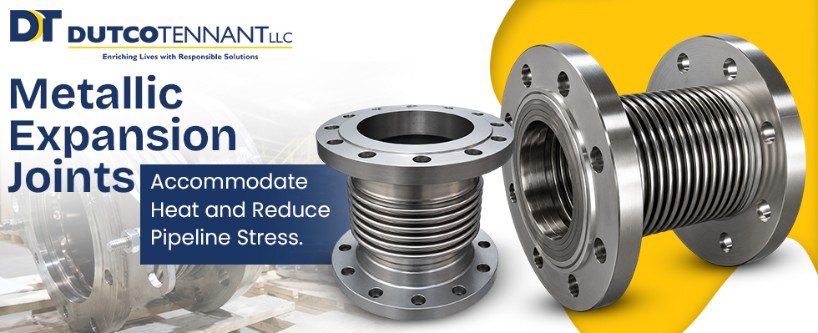
A metal bellows expansion joint uses a flexible, corrugated metallic element to accommodate specified movement within a piping system.
The bellows can deform elastically as the pipeline expands, contracts, or experiences certain changes in alignment, depending on the joint's design.
Unlike a rigid pipe connection, this flexible section allows controlled displacement while maintaining a pressure-containing boundary.
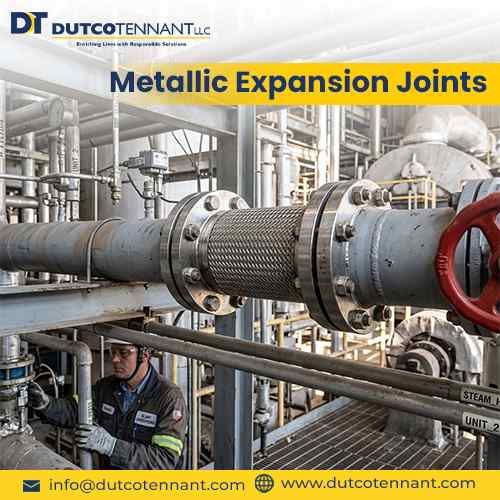
Metallic expansion joints are used in applications involving elevated temperatures, pressure variations, and movement between connected piping sections.
Our metallic expansion joints are intended for industrial systems where thermal movement, vibration, and mechanical stresses must be considered.
Understanding Different Types of Movement
Not every expansion joint accommodates movement in the same way. The required movement direction influences the joint configuration and its supporting arrangements.
- Axial movement: The pipe expands or contracts along its length. An appropriately selected axial expansion joint can accommodate this movement through compression or extension of the bellows.
- Lateral movement: Connected pipe ends move sideways relative to one another. Certain expansion joint configurations are designed to absorb this displacement.
- Angular movement: The joint accommodates rotation between connected pipe sections. Hinged or other purpose-designed arrangements may be used where angular movement is required.
A piping expansion joint should be selected according to the calculated movement rather than assuming that every bellows assembly can absorb all movement directions simultaneously.
Why Installing a Bellows Joint Alone Is Not Enough
One of the most important aspects of expansion joint design is understanding how the surrounding piping system behaves.
A metallic bellows assembly may accommodate thermal displacement, but it also introduces forces that must be considered.
For example, internal pressure acting on the effective area of an unrestrained bellows generates pressure thrust. This force can be considerable in steam systems operating at elevated pressures.
If the piping system lacks suitable anchors or an appropriate restrained expansion joint arrangement, pressure thrust can cause unintended movement and damage.
The expansion joint must therefore be evaluated as part of the complete piping layout.
The Role of Anchors and Guides
Anchors establish fixed reference points and resist the forces transferred through the pipeline.
Guides help direct pipe movement along the intended path and reduce the likelihood of lateral instability.
For axial expansion joint arrangements, the location and spacing of guides are particularly important.
A correctly selected thermal expansion compensator works with these supporting components rather than replacing their function.
Depending on the application, alternatives such as pipe loops, offsets, or restrained expansion joint assemblies may also be appropriate.
Metallic Expansion Joints for Steam and Hot-Water Applications
Steam pipelines and hot-water systems experience different combinations of temperature, pressure, and movement.
In steam distribution, operating temperatures can be high, and pressure thrust must be carefully assessed. Startup conditions, condensate management, and the possibility of water hammer also influence system design.
Hot-water circulation networks generally operate at lower temperatures than many industrial steam systems, but long pipe runs can still experience substantial expansion.
For both applications, metallic bellows assemblies can provide a compact method of accommodating calculated movement where suitable for the piping arrangement.
Selecting Materials for Operating Conditions
Metallic expansion joints commonly use stainless steel bellows or specialised alloys selected according to the service conditions.
Material selection should consider:
- Maximum and minimum operating temperatures
- Design pressure and pressure fluctuations
- Compatibility with the conveyed fluid
- Corrosion exposure
- Required movement capacity
- Expected operating cycles and fatigue life
These requirements influence the bellows material, thickness, number of convolutions, and overall assembly configuration.
The selected joint must also meet the applicable project specifications and design standards.
How Our Metallic Expansion Joint Solutions Support Industrial Piping
For steam and hot-water networks, we focus on selecting expansion joint configurations that correspond to the actual movement and operating conditions.
Our metallic expansion joint portfolio covers industrial piping applications where flexible connections are required to manage thermal expansion and mechanical movement.
Available configurations may include axial, lateral, and angular movement arrangements, with suitable bellows materials and end connections selected according to project requirements.
These solutions are relevant across:
- Power generation: Steam and auxiliary piping connected to boilers, turbines, and heat exchangers.
- Industrial processing: High-temperature process lines operating through repeated thermal cycles.
- District heating: Hot-water distribution pipelines exposed to changes in operating temperature.
- Oil and gas facilities: Process piping where thermal movement must be managed alongside pressure and material requirements.
- Commercial and industrial utilities: Heating and mechanical service networks requiring controlled pipeline flexibility.
As a metallic expansion joint supplier in UAE, we support project requirements involving temperature resistance, movement accommodation, and compatibility with industrial piping arrangements.
For an industrial expansion joint UAE installation, the selected assembly must be assessed against the complete system design, including anchor loads, guides, pressure thrust, and installation conditions.
Important Checks Before Installation
Even a correctly specified expansion joint can experience problems if installed incorrectly.
Before commissioning, the installation should be reviewed for the following:
- Correct installation length: The joint must be installed at the specified face-to-face dimension and preset position, where applicable.
- Alignment: Pipe ends should be positioned within the manufacturer's permitted tolerances.
- Anchor and guide arrangement: Supports must be installed according to the approved piping design.
- Movement direction: The joint should be installed to accommodate the intended displacement.
- Shipping restraints: Temporary shipping devices must be handled according to the manufacturer's installation instructions.
- Pressure and temperature limits: Operating conditions must remain within the specified ratings.
A metallic bellows joint should not be used to compensate for arbitrary installation misalignment unless that movement has been specifically included in its design.
Thermal Movement Should Be Addressed Before It Becomes a Maintenance Problem
In steam and hot-water pipelines, thermal expansion is unavoidable. The engineering challenge is determining where movement will occur and how the piping system will accommodate it safely.
When expansion is inadequately managed, the resulting forces can affect supports, equipment connections, and pressure-containing components. These effects may become more pronounced through repeated operating cycles.
A properly selected metallic expansion joint can accommodate calculated movement, but reliable performance also depends on suitable anchors, guides, materials, and installation practices.
By considering the entire piping arrangement, we can support industrial systems that manage thermal movement without placing unnecessary stress on connected equipment. For facilities operating steam and hot-water networks, this approach contributes to safer operation, reduced maintenance risks, and greater long-term piping reliability.