
Presenting Watts Hydraulic Balancing in Commercial HVAC Systems: Design Principles and Commissioning Best Practices by Dutco Tennant
A chilled-water system can meet every requirement on a design drawing and still struggle to deliver consistent cooling after installation. One floor may receive more water than required, another may experience insufficient flow, and the resulting adjustments can place unnecessary demand on pumps and other equipment.
These problems often become visible during commissioning, when actual system performance is compared with design expectations.
Achieving reliable HVAC operation requires more than selecting the correct pumps and chillers. Pipeline cleanliness, accurate hydronic balancing, and protection against sudden pressure changes all contribute to the performance of the water distribution network.
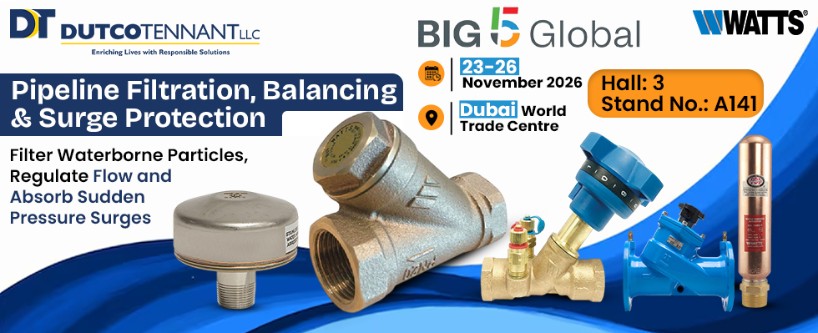
At Big 5 Global 2026, Dutco Tennant LLC will feature a selection of Watts flow control products that address these requirements. The range includes Y-type strainers, double regulating valves, and water hammer arrestors for commercial HVAC and compatible plumbing applications.
Through these HVAC solutions at Big 5 Global, we will highlight practical approaches to maintaining cleaner pipelines, establishing design flow rates, and protecting water distribution equipment.
Three Conditions That Influence Hydronic System Performance
A commercial chilled-water network distributes cooling through interconnected pipelines, pumps, valves, and terminal equipment. For the system to operate as intended, three conditions require particular attention.
- Water must reach equipment without excessive contamination. Dirt, rust particles, and installation debris can affect valves, control devices, and other components.
- Each circuit must receive its required flow rate. Uneven water distribution can lead to over circulation in some branches and insufficient flow in others.
- Pipework must withstand changes in operating conditions. Rapid valve closure and other transient events can generate pressure waves that stress connected plumbing equipment.
Watts addresses these requirements through products serving distinct roles within the water distribution system.
Protecting HVAC Equipment Before Balancing Begins
Hydronic balancing becomes difficult when strainers are blocked or debris interferes with control valves. For this reason, pipeline cleanliness should be considered before commissioning measurements are taken.
Watts YG11-20/20N – Bronze Y-Type Strainer
The Watts YG11-20/20N is a bronze Y-type strainer developed to remove impurities from circulating water and help protect downstream valves and equipment.
Its Y-shaped arrangement houses a straining element that captures solid particles as water passes through the pipeline. By reducing the movement of debris into sensitive components, the strainer helps maintain more reliable operation.
Watts identifies chilled-water, potable-water, and water-treatment installations among its applications.
For commercial building services, the YG11-20/20N can be considered where a Pipeline Y Strainer is required to protect compatible valves and equipment.
Its application is particularly relevant in systems where suspended particles could interfere with valve operation or restrict water passage.
The product also addresses requirements for a Plumbing Strainer or Water Filtration Strainer intended for mechanical particle removal. Unlike a fine water-treatment filtration system, a Y-strainer primarily protects equipment from debris carried through the pipeline.
For contractors evaluating a Y Strainer Dubai or Y Strainer GCC installation, the appropriate strainer should be selected according to operating pressure, fluid compatibility, connection requirements, and the specified filtration screen.
Watts W-W4112 – Ductile Iron Strainer for Industrial Pipelines
Larger water distribution systems may require a different strainer construction to accommodate their installation and operating requirements.
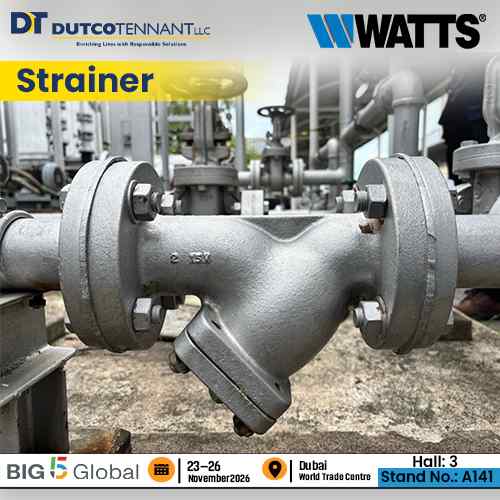
The Watts W-W4112 is a ductile iron Y-type strainer intended to remove impurities from pipeline media and support the normal operation of connected equipment.
According to Watts, the product features:
- Low flow resistance to help limit unnecessary pressure loss.
- Simple construction for convenient maintenance.
- Large dirt-holding capacity to accommodate accumulated debris.
- Convenient pollutant discharge for cleaning operations.
The manufacturer identifies water treatment, petroleum, chemical, and metallurgical applications as suitable areas of use, subject to fluid compatibility and product specifications.
For commercial HVAC installations, the W-W4112 can be considered as an HVAC Pipeline Strainer where its materials, ratings, and configuration meet the system requirements.
The larger industrial context also makes it relevant for Industrial Pipeline Strainer UAE projects involving suitable water distribution networks.
A well-selected Industrial Water Strainer helps protect downstream components, but maintenance remains essential. As debris accumulates, pressure loss across the strainer can increase, potentially affecting flow availability.
During commissioning, inspecting and cleaning strainers before final balancing helps ensure that flow measurements reflect normal operating conditions.
Setting the Correct Flow: Watts Double Regulating Valves
Once the distribution network is clean, the next challenge is ensuring that each circuit receives the required water quantity.
In an unbalanced system, water tends to favour circuits with lower hydraulic resistance. This can result in excessive flow through some branches while more remote circuits receive less than their design requirement.
A Double Regulating Valve allows flow to be adjusted during commissioning, helping establish the intended distribution of water across the system.
Watts offers balancing valve options for different pipeline sizes and operating requirements.
STBV-25/25N – Fixed Orifice Balancing for Accurate Commissioning
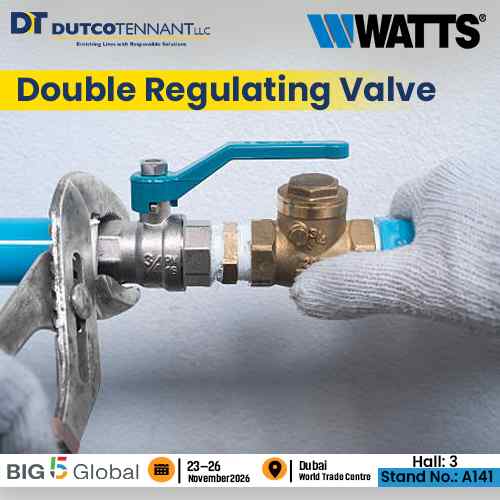
The Watts STBV-25/25N is a fixed-orifice double regulating valve developed for balancing cooling, heating, and process-water systems.
Its fixed-orifice measuring points allow commissioning professionals to obtain differential-pressure readings and determine flow using the relevant valve data.
This provides a practical method of adjusting individual circuits towards their specified flow rates.
The STBV-25/25N is particularly useful where commissioning requires repeatable measurements and controlled manual adjustment.
For example, a commercial building may have multiple chilled-water branches serving different air-handling units. Each branch has a design flow requirement based on its cooling load.
By using a Chilled Water Balancing Valve, commissioning teams can measure actual conditions and adjust flow distribution rather than relying on assumptions about the installed pipework.
The Manual Balancing Valve arrangement also supports subsequent verification when operating conditions or equipment configurations change.
As an HVAC Balancing Valve, the STBV-25/25N provides an important commissioning function in compatible heating and cooling networks.
W-STBV-16Q – Balancing Larger Chilled-Water Distribution Networks
Main distribution pipelines and larger HVAC branches present different balancing requirements from smaller terminal connections.
The Watts W-STBV-16Q is a static balancing valve available in the DN65–DN500 range. It is intended for flow balancing in cooling, heating, and process-water systems.
The valve incorporates several features that support commissioning and subsequent system checks:
- Accurate flow adjustment.
- Double-sided digital handwheel opening indication.
- Lockable preset position.
- Integrated shut-off function.
- Measuring points for troubleshooting.
These features allow technicians to adjust the valve, identify its opening position, and secure the selected setting after commissioning.
The Large Diameter Balancing Valve is particularly relevant where significant water quantities must be distributed between major branches.
In district cooling interfaces, large commercial buildings, and industrial HVAC networks, accurate flow allocation is essential for maintaining the intended hydraulic conditions.
The W-STBV-16Q can serve as a Chilled Water Flow Balancing Valve in suitable installations, helping commissioning teams establish the required distribution between circuits.
Its lockable setting is valuable where accidental adjustment could affect the balance of the network.
For projects specifying an Industrial HVAC Balancing Valve or Hydronic Flow Control Valve, the W-STBV range provides a manual balancing option that can be assessed against the required flow, pressure loss, and pipe diameter.
Commissioning Best Practices for Watts Balancing Valves
A balancing valve delivers its intended function only when it is correctly selected, installed, measured, and adjusted.
Commissioning should therefore follow a structured process rather than treating balancing as a final adjustment after the system is operational.
1. Establish the Design Flow Requirements
Before adjusting any valve, commissioning teams should confirm the required flow rates for the relevant branches and terminal units.
These values are normally derived from the system design, equipment schedules, and specified operating temperature differences.
Without a reliable design reference, measured flow alone cannot establish whether a circuit is correctly balanced.
2. Verify Pipeline Cleanliness
Debris accumulated during construction and installation can obstruct strainers and affect water circulation.
The YG11-20/20N and W-W4112 strainers should be inspected and cleaned as required before final balancing.
A partially blocked strainer may create additional pressure loss, producing misleading results during valve adjustment.
3. Confirm Stable Operating Conditions
Pumps, control valves, and connected equipment should be operating under the specified commissioning conditions.
Changes in pump speed or control-valve position during measurement can affect the differential pressure available across balancing devices.
For variable-flow systems, the commissioning procedure must account for the relevant control strategy and operating mode.
4. Measure and Adjust Flow
The STBV-25/25N and W-STBV-16Q provide measurement arrangements that support flow verification.
Commissioning technicians can use suitable differential-pressure instruments and manufacturer valve data to determine flow and adjust the valve accordingly.
The objective is to achieve the specified flow without introducing unnecessary resistance.
5. Record and Secure Final Settings
Once the required distribution is established, valve positions and measured results should be documented.
Where supported, preset positions should be locked to reduce the risk of accidental changes.
These records provide a useful reference for future maintenance, troubleshooting, and system modifications.
Proper commissioning helps reduce the likelihood of unresolved flow imbalances, although system performance also depends on pump selection, control strategies, equipment operation, and overall hydraulic design.
Managing Sudden Pressure Changes in Plumbing Systems
Hydronic balancing focuses on establishing appropriate water distribution. A separate concern arises when moving water is forced to stop or change velocity rapidly.
When a quick-closing valve shuts, the momentum of flowing water can generate a pressure wave through the pipeline. This phenomenon, commonly known as water hammer, may produce noise, vibration, and stress on connected components.
Watts provides dedicated Water Hammer Arrestor solutions to absorb pressure shocks in suitable plumbing installations.
These devices complement the broader objective of maintaining dependable water distribution, although they are not substitutes for balancing valves or comprehensive surge protection in large pumping networks.
Watts 15M2 – Water Hammer Control for Commercial Plumbing
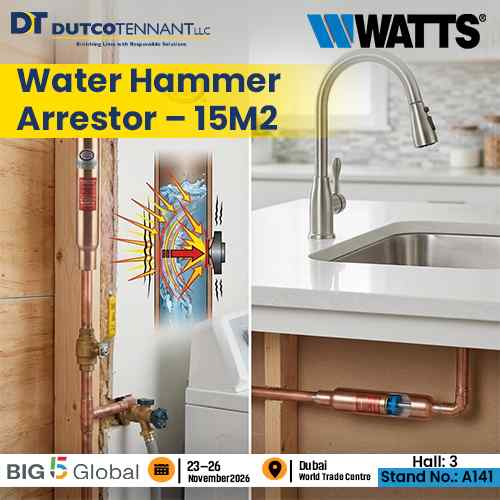
The Watts 15M2 is a piston-type water hammer arrestor intended for commercial and industrial plumbing applications.
Its construction includes a copper body, EPDM seals and O-rings, a polypropylene piston, and a solid brass NPT adapter.
The device incorporates a sealed air chamber that absorbs pressure shocks caused by rapid changes in water flow.
Watts specifies a factory air charge of 60 psi (4.2 bar). The unit is not rechargeable in the field and has a maximum working pressure of 150 psi.
The 15M2 can be installed in new or existing plumbing systems and is suitable for concealed locations under the manufacturer's installation guidance.
The product is particularly relevant near quick-closing equipment such as commercial dishwashers, washing machines, and certain plumbing fixtures.
As a Plumbing Shock Arrestor, it helps reduce the impact of hydraulic pressure changes that can otherwise cause pipe vibration and noise.
For commercial properties requiring a Water Hammer Protection Device, the 15M2 offers a compact solution for appropriate plumbing installations.
Its application can support Plumbing Surge Protection at selected fixtures, provided the device is correctly sized and installed.
Watts SS Series – Stainless Steel Shock Arrestors
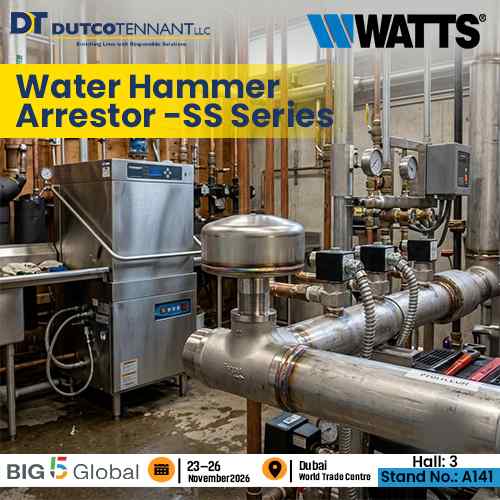
The Watts SS Series provides another approach to controlling water hammer, using a stainless steel bellows-type construction.
These pre-charged arrestors feature an all-stainless-steel assembly, including stainless steel bellows, together with a male IPS threaded connection.
The series is intended for domestic and commercial water lines and is specified for working pressures up to 150 psi and static pressures up to 250 psi.
Watts also identifies a temperature range of -73°C to 149°C and states that maintenance access is not required for the product.
The Stainless Steel Water Hammer Arrestor is suitable for projects where a bellows-type device is specified for compatible water supply installations.
Its construction helps absorb sudden pressure fluctuations while providing a compact component for incorporation into plumbing pipework.
For commercial building services, the SS Series can be evaluated as a Water Hammer Suppressor to help reduce noise and vibration associated with rapid valve closure.
The series is also relevant to Hydraulic Shock Protection requirements where its pressure, temperature, connection, and installation specifications match the application.
Bringing Filtration, Balancing, and Pressure Protection into the Same Design Strategy
Although the featured Watts products perform different functions, they contribute to a common objective: maintaining reliable water distribution.
Consider a commercial building with several chilled-water branches and extensive plumbing services.
Strainers help prevent debris from reaching valves and connected equipment. Double regulating valves allow technicians to establish the required flow distribution during commissioning. Water hammer arrestors protect selected plumbing connections against pressure shocks caused by quick-closing devices.
Each component addresses a different hydraulic condition.
The effectiveness of the overall installation depends on selecting these products for the correct locations and operating requirements.
For consultants and contractors, this means considering:
- Flow characteristics: Required water quantity, expected velocity, and allowable pressure loss.
- System cleanliness: Potential debris sources and access for strainer maintenance.
- Commissioning requirements: Measurement points, valve adjustment, and documentation.
- Pressure conditions: Normal operating pressure and possible transient events.
- Long-term operation: Accessibility, maintenance procedures, and compatibility with the building's control strategy.
This coordinated approach can support more predictable system performance and simplify future troubleshooting.
Watts HVAC Solutions at Big 5 Global 2026
Commercial HVAC projects demand careful attention to hydraulic design, particularly where extensive chilled-water networks serve multiple floors, buildings, or operating zones.
The Watts products featured by Dutco Tennant LLC address important stages of this process, from protecting equipment against debris to establishing flow distribution and managing pressure shocks in connected plumbing installations.
During Big 5 Global Exhibition 2026, we will present these solutions to MEP consultants, HVAC contractors, commissioning specialists, developers, and facility management professionals.
The exhibition provides an opportunity to examine product selection considerations and discuss the role of strainers, balancing valves, and water hammer arrestors in commercial building services.
Exhibition Details
Big 5 Global 2026
23–26 November 2026
Dubai World Trade Centre
Hall 3 | Stand A141
We invite visitors to explore our Watts product selection and discuss the practical requirements of achieving reliable hydraulic performance across commercial HVAC and plumbing networks.